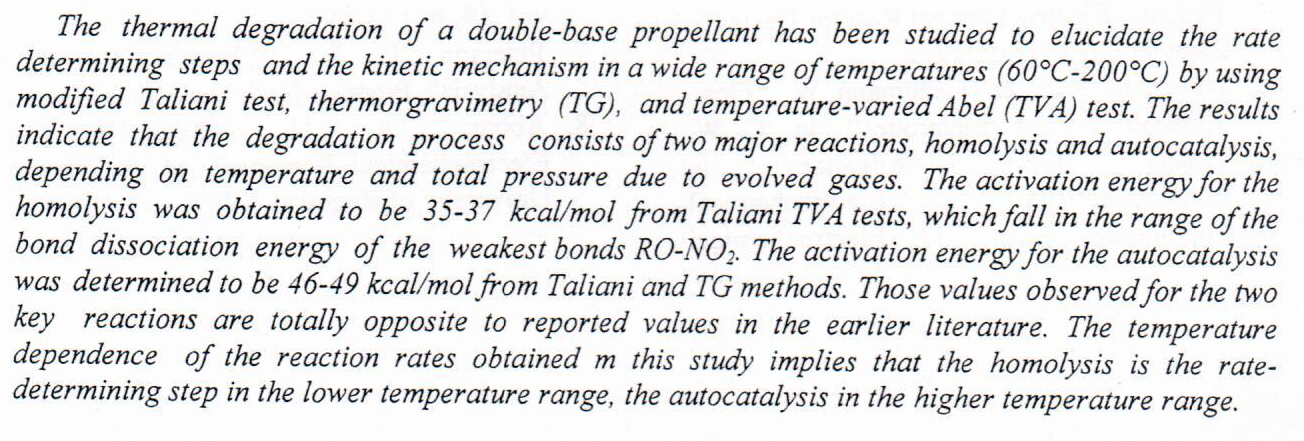
Kinetic Mechanism on Thermal Degradation of a Nitrate Ester Propellant

Purpose Heavy metals are toxic pollutants released into the environment as a result of different industrial activities. Biosorption of heavy metals from aqueous solutions is a new technology for the treatment of industrial wastewater. The aim of the present research is to highlight the basic biosorption theory to heavy metal removal. Materials and methods Heterogeneous cultures mostly dried anaerobic bacteria, yeast (fungi), and protozoa were used as low-cost material to remove metallic cations Pb(II), Cr(III), and Cd(II) from synthetic wastewater. Competitive biosorption of these metals was studied. Results The main biosorption mechanisms were complexation and physical adsorption onto natural active functional groups. It is observed that
... Show More (54)
(54)

 (12)
(14)
(12)
(14)


In this investigation, deep eutectic solvent based on propionic acid and choline chloride was used to prepare polyaniline, polypyrrole, and poly(aniline-co-pyrrole) samples using chemical oxidation and polymerization. Quantum mechanical calculations were conducted using time-dependent density functional theory to determine the electronic, spectroscopic properties and structure of homopolymers and the copolymer which were compared with the respective experimental data. Furthermore, the synthesized materials were characterized using Fourier transform IR spectroscopy, scanning electron microscopy (SEM), UV-visible spectroscopy, and thermogravimetric analysis. IR and UV-visible spectra confirmed copolymerization, and SEM revealed that the copol
... Show More
(13)
(14)
(1)
The thermal and electrical performance of different designs of air based hybrid photovoltaic/thermal collectors is investigated experimentally and theoretically. The circulating air is used to cool PV panels and to collect the absorbed energy to improve their performance. Four different collectors have been designed, manufactured and instrumented namely; double PV panels without cooling (model I), single duct double pass collector (model II), double duct single pass (model III), and single duct single pass (model IV) . Each collector consists of: channel duct, glass cover, axial fan to circulate air and two PV panel in parallel connection. The temperature of the upper and lower surfaces of PV panels, air temper
... Show More
(3)
Abstract
Metal cutting processes still represent the largest class of manufacturing operations. Turning is the most commonly employed material removal process. This research focuses on analysis of the thermal field of the oblique machining process. Finite element method (FEM) software DEFORM 3D V10.2 was used together with experimental work carried out using infrared image equipment, which include both hardware and software simulations. The thermal experiments are conducted with AA6063-T6, using different tool obliquity, cutting speeds and feed rates. The results show that the temperature relatively decreased when tool obliquity increases at different cutting speeds and feed rates, also it
... Show MorePolycrystalline ingots of cadmium telluride have been synthesized using the direct
reaction technique, by fusing initial component consisting from pure elements in
stoichiometric ratio inside quartz ampoule is evacuated 10-6 torr cadmium telluride has
been grown under temperature at (1070) oC for (16) hr. was used in this study, the phases
observed in growing CdTe compound depend on the temperature used during the growth
process. Crystallography studies to CdTe compound was determined by X-ray diffraction
technique, which it has zinc blend structure and cubic unit cell, which lattice constants is
a=6.478
oA
Thin films of highly pure (99.999%) Tellurium was prepared by high vacuum technique (5*10-5torr), on glass substrates .Thin films have thickness 0.6m was evaporated by thermal evaporation technique. The film deposited was annealed for one hour in vacuum of (5*10-4torr) at 373 and 423 K. Structural and electrical properties of the films are studies. The x-ray diffraction of the film represents a poly-crystalline nature in room temperature and annealed film but all films having different grain sizes. The d.c. electrical properties have been studied at low and at relatively high temperatures and show that the conductivity decreases with increasing temperature at all range of temperature. Two types of conduction mechanisms were found to d
... Show More
(1)
By using governing differential equation and the Rayleigh-Ritz method of minimizing the total potential energy of a thermoelastic structural system of isotropic thermoelastic thin plates, thermal buckling equations were established for rectangular plate with different fixing edge conditions and with different aspect ratio. The strain energy stored in a plate element due to bending, mid-plane thermal force and thermal bending was obtained. Three types of thermal distribution have been considered these are: uniform temperature, linear distribution and non-linear thermal distribution across thickness. It is observed that the buckling strength enhanced considerably by additional clamping of edges. Also, the thermal buckling temperatures and
... Show More
(6)