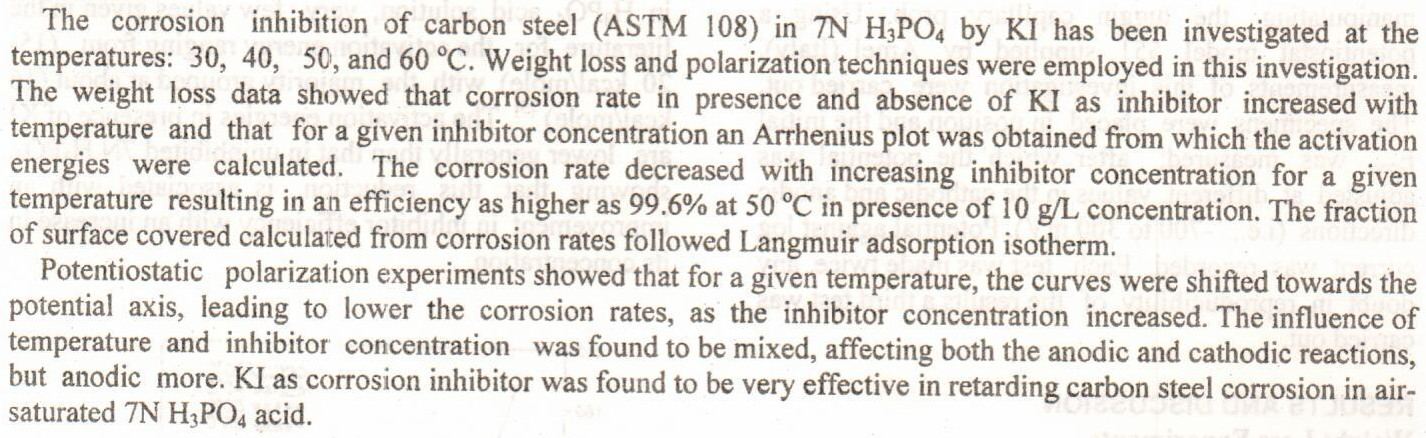
The Influence of Temperature on Corrosion Inhibition of Carbon Steel in Air-Saturated 7NH3PO4 by Potassium Iodide

Steel corrosion in acidic environments is a critical industrial challenge, necessitating effective yet eco-friendly inhibitors. This study aims to address this problem by introducing a novel, green alternative: frankincense extract (FE). The distinctive contribution of this work lies in the comprehensive investigation of FE natural, sustainable, and economically viable resin as an effective corrosion inhibitor for carbon steel in 1 M HCl. The research employs an integrated methodology, including electrochemical techniques (potentiodynamic polarization (PDP) and electrochemical impedance spectroscopy (EIS)), adsorption isotherm modeling, surface analysis (FT-IR and FESEM/EDX), and density functional theory (DFT) calculations. Key res
... Show MorePreviously, many empirical models have been used to predict corrosion rates under different CO2 corrosion parameters conditions. Most of these models did not predict the corrosion rate exactly, besides it determined effects of variables by holding some variables constant and changing the values of other variables to obtain the regression model. As a result the experiments will be large and cost too much. In this paper response surface methodology (RSM) was proposed to optimize the experiments and reduce the experimental running. The experiments studied effects of temperature (40 – 60 °C), pH (3-5), acetic acid (HAc) concentration (1000-3000 ppm) and rotation speed (1000-1500 rpm) on CO2 corrosion performance of t
... Show MoreThe corrosion inhibition of aluminum alloy 5083 by an environment friendly compound called (8- Hydroxyquinoline) in
acidic and alkaline solutions of pH (2 and 12) respectively were studied using weight loss and polarization techniques.
Also to examine the main and combined effects of the inhibitor concentration, pH, and contact time using factorial
experimental design. Results show that corrosion rate decreased with increasing both inhibitor concentration and
contact time and increased with increasing pH value. The polarization curves show that 8-hydroxyquinoline is a
cathodic inhibitor
The galvanic corrosion of the (Cu - Fe), (Cu - Zn) and (Fe - Zn) couples have been investigated in 3.5% NaCl solution, 40ºC, different velocities (Re = 5000, 10000 and 15000) and different area ratio’s of cathode to anode (AR= 0.5,1 and 2), by using commercial metal pipe (cylindrical tube).The Zero Resistance Ammeter has been used to measure the galvanic current (Ig) and galvanic potential (Eg) with time. The galvanic current density increases with increasing velocity (Re) and the area ratio (AR). The galvanic potential (Eg) is shifted to less negative with increasing velocity (Re) and the area ratio (AR). A statistical relations for the galvanic current density and galvanic potential as a function of (Re). and the area ratio had been
... Show MoreThe research involved attempt to inhibit the corrosion of Al-Si-Cu alloy in 2.5x10⁻³ mol.dm-3 NaOH solution (pH=11.4) by addition of six different inhibitors with three concentrations (1x10⁻³, 1x10⁻², and 0.1 mol.dm-3). These inhibitors include three organic materials (sodium acetate, sodium benzoate, and sodium oxalate) and three inorganic materials (sodium chromate, disodium phosphate, and sodium sulphate). The data that concerning polarization behaviour are calculates which include the corrosion potential (Ecorr) and current density (icorr), cathodic and anodic Tafel slopes (bc & ba), and polarization resistance (Rp). Protection efficiency (P%) and activation energy (Ea) values were calculated for inhibition by the six inhibitors. The
... Show More
The ability to inhibit corrosion of low carbon steel in a salt solution (3.5%NaCl) has been checked with three real expired drugs (Cloxacillin, Amoxicillin, Ceflaxin) with variable concentrations (0, 250, 500, 750) mg/L were examined in the weight loss. The inhibition efficiency of the Cloxacillin 750 mg/L showed the highest value (82.8125 %) and the best inhibitor of the rest of the antibiotics. The different concentrations of Cloxacillin drug (0, 250, 500, 750) mg/L and temperature (25, 35, 45, 55) oC were studied as variables with potentiodynamic polarization, Scanning Electron Microscopy (SEM) for surface morphology and electrochemical impedance spectroscopy (EIS) depending on current values and the resistance of charge to
... Show More (3)
(3)
 (2)
(2)

Nanoparticles (NPs) based techniques have shown great promises in all fields of science and industry. Nanofluid-flooding, as a replacement for water-flooding, has been suggested as an applicable application for enhanced oil recovery (EOR). The subsequent presence of these NPs and its potential aggregations in the porous media; however, can dramatically intensify the complexity of subsequent CO2 storage projects in the depleted hydrocarbon reservoir. Typically, CO2 from major emitters is injected into the low-productivity oil reservoir for storage and incremental oil recovery, as the last EOR stage. In this work, An extensive serious of experiments have been conducted using a high-pressure temperature vessel to apply a wide range of CO2-pres
... Show MoreProtection study of the corrosion behavior of Copper surface was conducted with several concentrations of drug. Experimentally, voltammetric measurements were used to check the inhibition eciency (% IE) in saline solution of 3.5% NaCl. The results showed an increase in the inhibition eciency with increasing the concentration of the drug was 95.90%. Theoretical treatment of the drug in the gas phase was performed using the (hyperchem-8.07) program for molecular mechanics and semi-empirical computations. The (PM3) approach was used to determine the heat of formation (1H°f), binding energy (1Eb), and total energ
(1)
Protection study of the corrosion behavior of Copper surface was conducted with several concentrations of drug. Experimentally, voltammetric measurements were used to check the inhibition efficiency (% IE) in saline solution of 3.5% NaCl. The results showed an increase in the inhibition efficiency with increasing the concentration of the drug was 95.90%. Theoretical treatment of the drug in the gas phase was performed using the (hyperchem-8.07) program for molecular mechanics and semi-empirical computations. The (PM3) approach was used to determine the heat of formation (1H˚f), binding energy (1Eb), and total energy (ET
(2)
The present study was conducted to evaluate the effect of different inhibitors on the corrosion rate of aluminum in 50% (v/v) ethylene glycol solution at 80°C and pH 8.0 in which the electrochemical technique of linear sweep voltammetry was employed to characterize each inhibitor function and to calculate the corrosion rate from Tafel plots generated by a computer assisted potentiostat.
It is found that both sodium dichromate and borax reduces the corrosion rate by polarizing the anodic polarization curve while sodium phosphate, potassium phosphate, and sodium benzoate reduces the corrosion rate by polarizing both the anodic and cathodic polarization curve.
When inhibitor concentration increases from I g/l up
... Show More