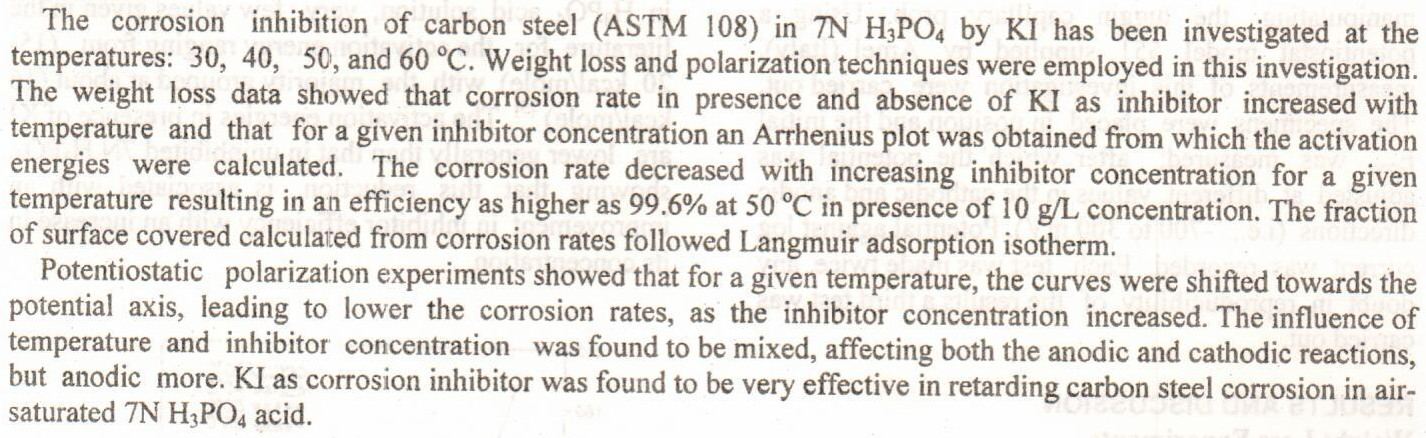
The Influence of Temperature on Corrosion Inhibition of Carbon Steel in Air-Saturated 7NH3PO4 by Potassium Iodide


Due to the broad range uses of chromium for industrial purposes, besides its carcinogenic effect, an efficient, cost effective removal method should be obtained. In this study, cow bones as a cheap raw material were utilized to produce active carbon (CBAC) by physiochemical activation, which was characterized using: SEM to investigate surface morphology and BET to estimate the specific surface area. The best surface area of CBAC was 595.9 m2/gm which was prepared at 600 ᵒC activation temperature and impregnation ratio of 1:1.5. CBAC was used in aqueous chromium ions adsorption. The investigated factors and their ranges are: initial concentration (10-50 mg/L), adsorption time (30-300 min), temperature (20-50
... Show More (9)
(9)

Refrigerant R134a has been widely utilized in automotive air conditioning systems (AACSs); R134a has a high global warming potential (GWP) of 1430 despite having zero ozone depletion potential (ODP). Coming refrigeration systems must include refrigerants with low GWP and zero ODP. The aim of this experimental study is to evaluate the thermal performance of an (AAC) with different values of compressor speeds, i.e., (1000, 1700, and 2400 rpm) and two thermal loads, i.e., (500 and 1000 Watt) with the absence and presence of liquid suction heat exchanger (LSHX) using R134a. The results showed that adding LSHX enhanced the COP cycle by 7.18%, 10.7%, and 3.09% for the first, second, and third speed, respectively, at 500 Watt, while the en
... Show More
Search Results at the International Journal of Science and Research (IJSR)
The main objective of this study is to determine whether the use of He-Ne Laser (632.8 nm wavelength and power 0.5 mW) is an eligible and effective tool to kill or reduce the cell viability of Candida albicans isolated from complete upper dentures. Twenty one swabs were taken from the complete upper dentures. Only six swabs showed positive cultures for C. albicans. The isolate was divided into two groups, group I was not irradiated (control), and group II was irradiated by He-Ne Laser for different periods (10, 15, 20, and 30) min. After irradiation, the results showed a significant reduction in the viable cell count and colonies diameters especially at exposure periods 10 and 15 min. Although the low power He-Ne Laser was not eradicating t
... Show More
The nonlinear optical properties response of nematic liquid crystal (6CHBT) and the impact of doping with two kinds of nanoparticles; Fe3O4 magnetic nanoparticles and SbSI ferroelectric nanoparticles have been studied using the non-linear dynamic method through z-scan measurement technique. This was achieved utilizing CW He-Ne laser. The pure LC and magnetic LC nanoparticle composite samples had a maximum absorption while the ferroelectric LC nanoparticle composite had a minimum absorption of the incident light. The nonlinear refractive index was positive for the pure LC and the rod-like ferronematic LC composite samples, while it was negative for the ferroelectric LC composite. The studying of the nonlinear optical
... Show More
(1)
The semiconductor ZnO is one of II – VI compound group, it is prepare as thin films by using chemical spray pyrolysis technique; the films are deposited onto glass substrate at 450 °C by using aqueous zinc chloride as a spray solution of molar concentration 0.1 M/L. Sample of the prepared film is irradiating by Gamma ray using CS 137, other sample is annealed at 550°C. The structure of the irradiated and annealed films are analyzed with X-ray diffraction, the results show that the films are polycrystalline in nature with preferred (002) orientation. The general morphology of ZnO films are imaged by using the Atomic Force Microscope (AFM), it constructed from nanostructure with dimensions in order of 77 nm.
The optical properties o
Nanofluid treatment of oil reservoirs is being developed to enhance oil recovery and increase residual trapping capacities of CO2 at the reservoir scale. Recent studies have demonstrated good potential for silica nanoparticles for enhanced oil recovery (EOR) at ambient conditions. Nanofluid composition and exposure time have shown significant effects on the efficiency of EOR. However, there is a serious lack of information regarding the influence of temperature on nanofluid performance; thus the effects of temperature, exposure time and particle size on wettability alteration of oil-wet calcite surface were comprehensively investigated; moreover, the stability of the nanofluids was examined. We found that nanofluid treatment is more efficie
... Show More (167)
(160)
(167)
(160)
