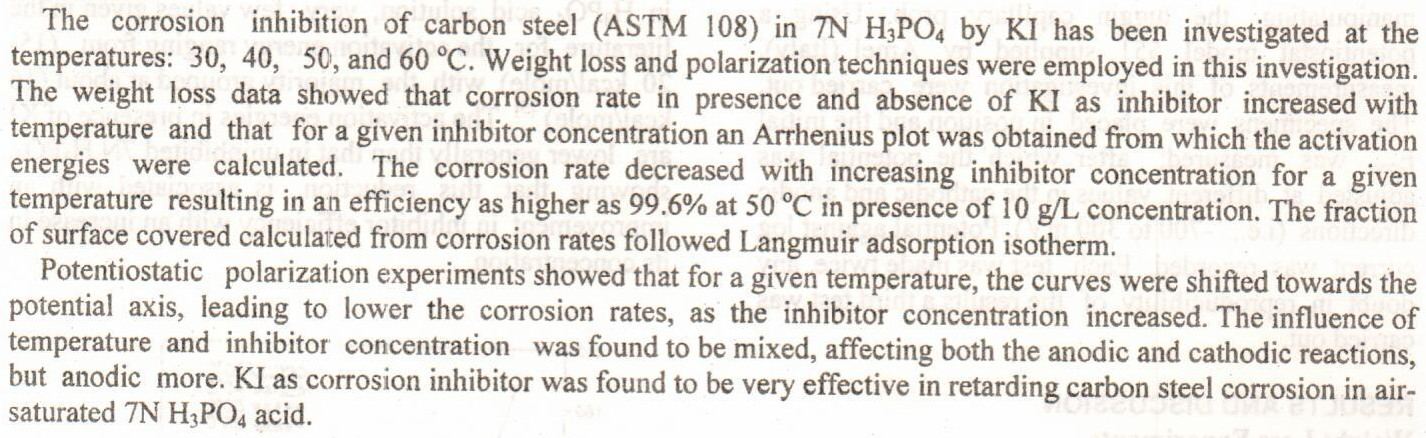
The Influence of Temperature on Corrosion Inhibition of Carbon Steel in Air-Saturated 7NH3PO4 by Potassium Iodide

High performance self-consolidating concrete HP-SCC is one of the most complex types of concrete which have the capacity to consolidated under its own weight, have excellent homogeneity and high durability. This study aims to focus on the possibility of using industrial by-products like Silica fumes SF in the preparation of HP-SCC enhanced with discrete steel fibers (DSF) and monofilament polypropylene fibers (PPF). From experimental results, it was found that using DSF with volume fraction of 0.50 %; a highly improvements were gained in the mechanical properties of HP-SCC. The compressive strength, splitting tensile strength, flexural strength and elastic modulus improved about 65.7 %, 70.5 %, 41.7 % and 80.3 % at 28 days age, respectively
... Show MoreCollapsible behaviour of soil is considered as one of the major problems in the stability of roadway embankment, the lack of cohesion between soil particles and its sensitivity to the change of moisture content are reasons for such problem. Creation of such cohesion may be achieved by implementation of liquid asphalt and introduction of Nano additives. In this work, silica fumes, fly ash and lime have been implemented with the aid of asphalt emulsion to improve the unconfined compressive strength of the collapsible soil. Specimens of 38 mm in diameter and 76 mm height have been prepared with various percentages of each type of Nano additive and fluid content. Specimens were subjected to unconfined compressive strength determination at dry a
... Show MoreNon-thermal argon plasma needle at atmospheric pressure was
constructed. The experimental setup was based on a simple and low
cost electric component that generates a sufficiently high electric
field at the electrodes to ionize the argon gas which flow at
atmospheric pressure. A high AC power supply was used with 1.1
kV and 19.57 kHz. Non-thermal Argon plasma used on blood
samples to show the ability of non-thermal plasma to promote blood
coagulation. Three tests have been done to show the ability of plasma
to coagulate both normal and anti-coagulant blood. Each blood
sample has been treated for varying time from 20sec. to 180sec. at
different distances. The results of the current study showed that the
co

In this study, hydroxyapatite (HAP, Ca10(PO4)6(OH)2) has been prepared as bioceramic material with biological specifications useful to used for orthopedic and dental implant applications. Wet chemical processing seems to form the fine grain size and uniform characteristic nanocrystalline materials by the interstice factors controlling which affected the grain size and crystallinity in order to give good mechanical and/or constituent properties similar as natural bone. Fluorinated hydroxyapatite [4-6 wt% F, (FHA, Ca10(PO4)6(OH)2–Fx] was developed in new method for its posses to increased strength and to give higher corrosion resistance in biofluids than pure HAP moreover reduces the risk of dental caries. The phase's and functional groups
... Show More (4)
(4)
This paper represents an experimentalattempt to predict the influence of CO2-MAG welding variables on the shape factors of the weld joint geometry. Theinput variables were welding arc voltage, wire feeding speed and gas flow rate to investigate their effects on the shape factorsof the weld joint geometry in terms of weld joint dimensions (bead width, reinforcement height, and penetration). Design of experiment with response surface methodology technique was employed to buildmathematical models for shape factors in terms of the input welding variables. Thepredicted models were found quadratic type and statistically checked by ANOVA analysis for adequacy purpose. Also, numerical and graphical optimizations were carried out
... Show MoreThe research aims to know the impact of workers values on their performance which is reflected on increasing productivity and improving its quality as well as the organization's progress and success. Application of this research took place in the General Company Of Electrical Industries; it contained four main pillars; the first involved research methodology، regarding the problem، importance، aim، basic theory، and method of data collection، the second is dedicated to the theoretical framework related to the research basic variables (values and workgroups) the third is assigned to analyze the actual data by using number of statistical methods، such as mathematical medium and standard deviation and also spearman rank
... Show More
Abstract
Magnetic abrasive finishing (MAF) is one of the advanced finishing processes, which produces a high level of surface quality and is primarily controlled by a magnetic field. This paper study the effect of the magnetic abrasive finishing system on the material removal rate (MRR) and surface roughness (Ra) in terms of magnetic abrasive finishing system for eight of input parameters, and three levels according to Taguchi array (L27) and using the regression model to analysis the output (results). These parameters are the (Poles geometry angle, Gap between the two magnetic poles, Grain size powder, Doze of the ferromagnetic abrasive powder, DC current, Workpiece velocity, Magnetic poles velocity, and Finishi
... Show More