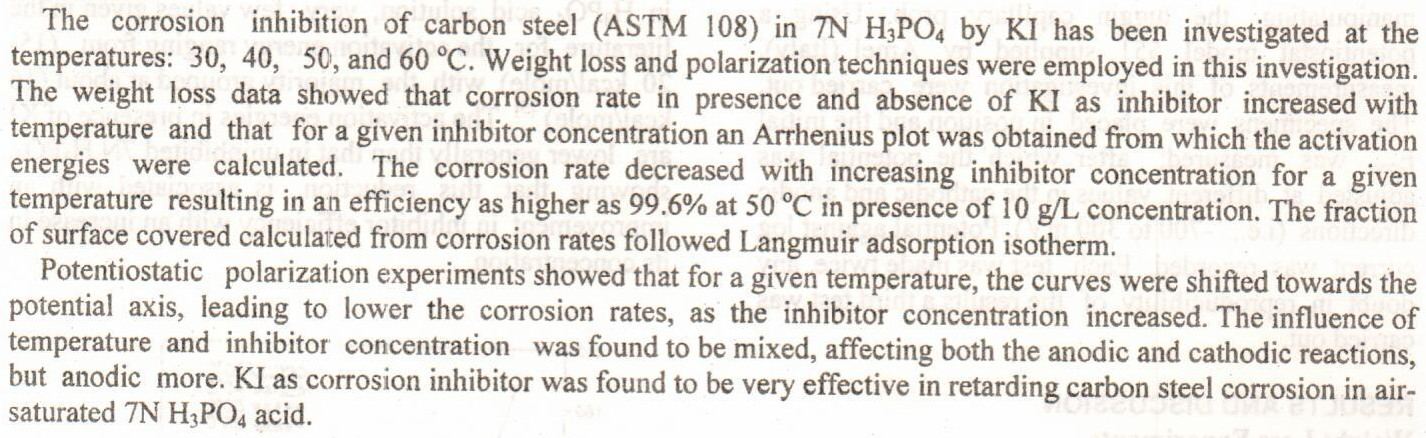
The Influence of Temperature on Corrosion Inhibition of Carbon Steel in Air-Saturated 7NH3PO4 by Potassium Iodide

Failure in asphalt mixture and distress in pavement are major issues to roads infrastructure. Selecting an appropriate chemical composition of asphalt cement is a key component in avoiding these issues. This work aimed to investigate the effect of the chemical composition of different polar fractions on the rheological and physical properties of asphalt cement. Four types of asphalt cement with penetration grades of 20/30, 40/50, 60/70 and 85/100 were divided into four fractions. Complex shear modules, rutting resistance and rotational viscosity of the asphalt cement were determined by using a Dynamic Shear Rheometer and a Rotation Viscometer, respectively. The results show that an increase in the asphaltene content and Gastel index resulte
... Show MoreCarbon nanoparticles are prepared by sonication using carbon black powder. The surface morphology of carbon black (CB) and carbon nanoparticles (CNPs) is investigated using scanning electron microscopy (SEM). The particles size ranges from 100 nm to 400 nm for CB and from 10 nm to 100 nm for CNPs. CNPs and CB are mixed with silicon glue of different ratios of 0.025, 0.2, 0.05, and 0.1 to synthesis films. The optical properties of the prepared films are investigated through reflectance and absorbance analyses. The ratio of 0.05 for CNPs and CB is the best for solar paint because of its higher solar water heater efficiency and is then added to the silicon glue . Temperature of cold water and temperature of hot water in storage tank were ta
... Show More (1)
(1)

In this work, MWCNT in the epoxy can be prepared at room temperature and thickness (1mm) at different concentration of CNTs powder. Optical properties of multi-walled carbon nanotubes (CNTs) reinforced epoxy have been measured in the range of (300-800)nm. The electronic transition in pure epoxy and CNT/epoxy indicated direct allowed transition. Also, it is found that the energy gap of epoxy is 4.1eV and this value decreased within range of (4.1-3.5)eV when the concentration of CNT powder increased from (0.001-0.1)% respectively.
The optical constants which include (the refractive index (n), the extinction coefficient (k), real (ε1) and imaginarily (ε2) part of dielectric constant calculated in the of (300-800)nm at different concent
This study investigates the surgical and thermal effects on oral soft tissues produced by CO2 laser emitting at 10.6 micrometers with three different fluences 490.79, 1226.99 and 1840.4 J/cm2. These effects are specifically; incision depth, incision width and the tissue damage width and depth. The results showed that increasing the fluence and /or the number of beam passes increase the average depths of ablation. Moreover, increasing the fluence and the number of beam passes increase the adjacent tissue damage in width and depth. Surgeons using CO2 laser should avoid multiple pulses of the laser beam over the same area, to avoid unintentional tissue damage.
Electrochemical method was used to prepare carbon quantum dots (CQDs). Size of matter was nature when evaluate via X-ray diffraction (XRD). A distinct peak at 2θ equal to 31.6° and three other small peaks at 38.28°, 56.41° and 66.12° were observed. The measures of Fourier Transform Infrared Spectroscopy (FTIR) showed the bonds in the transmittance spectrum are manufactured with carbon nanostructures in view. The first peaks are the O–H stretching vibration bands at (3417 and 2922) cm−1, (C–O–H at 1400, and 1317) cm−1, (C–H), (C=C), (C–O–H), (C=O), and (C–O) bonds at 2850, 1668, 1101, and 1026 cm−1 sequentially. The transmission electron microscopy (TEM) results presented that the spherical CQDs are in shape and on a
... Show More (1)
(1)


Functionalized-multi wall carbon nanotubes (F-MWCNTs) and functionalized-single wall carbon nanotubes (F-SWCNTs) were well enhanced using CoO Nanoparticles. The sensor device consisted of a film of sensitive material (F-MWCNTs/CoONPs) and (F-SWCNTs/CoO NPs) deposited by drop- casting on an n-type porous silicon substrate. The two sensors perform high sensitivity to NO2 gas at room temperatures. The analysis indicated that the (F-MWCNTs/CoONPs) have a better performance than (F-SWCNTs/CoONPs). The F-SWCNTs/CoONPs gas sensor shows high sensitivity (19.1 %) at RT with response time 17 sec, while F-MWCNTs/CoONPs gas sensor show better sensitivity (39 %) at RT with response time 13 sec. The device shows a very reproducible sensor p
... Show More
(6)
(13)
Castellated columns are structural members that are created by breaking a rolled column along the center-line by flame after that rejoining the equivalent halves by welding such that for better structural strength against axial loading, the total column depth is increased by around 50 percent. The implementation of these institutional members will also contribute to significant economies of material value. The main objectives of this study are to study the enhancement of the load-carrying capacity of castellated columns with encasement of the columns by Reactive Powder Concrete (RPC) and lacing reinforcement, and serviceability of the confined castellated columns. The Castellated columns with RPC and Lacing Reinforcement improve com
... Show More
(2)
(2)
Crude oil is one of the most important sources of energy in the world. To extract its multiple components, we need oil refineries. Refineries consist of multiple parts, including heat exchangers, furnaces, and others. It is known that one of the initial operations in the refineries is the process of gradually raising the temperature of crude oil to 370 degrees centigrade or higher. Hence, in this investigation the focus is on the furnaces and the corrosion in their tubes. The investigation was accomplished by reading the thickness of the tubes for the period from 2008 to 2020 with a test in every two year, had passed from their introduction into the work. Where the thickness of more than one point was measured on each tube in the sa
... Show More
(6)
(7)
