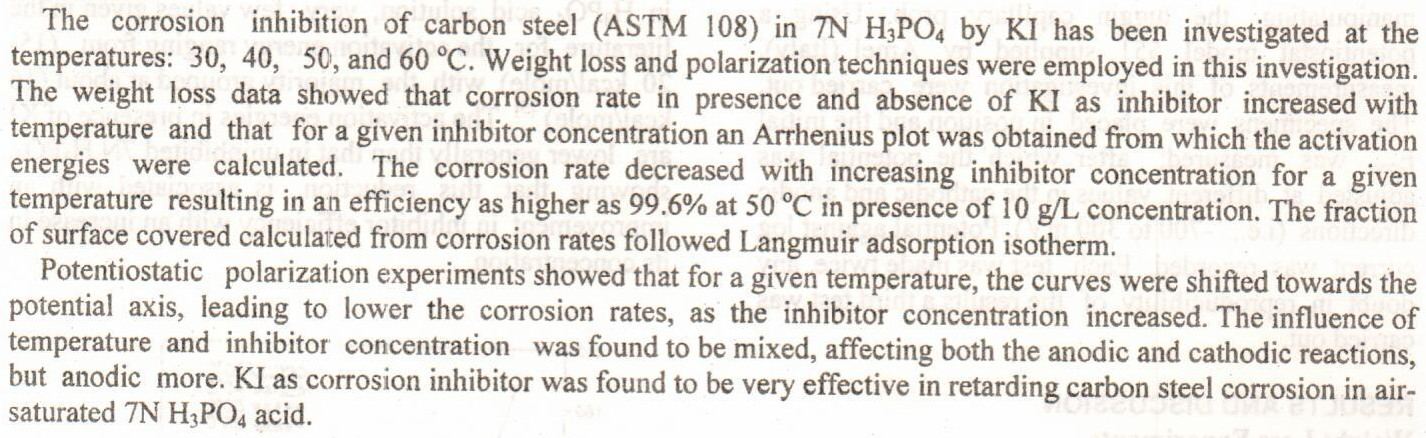
The Influence of Temperature on Corrosion Inhibition of Carbon Steel in Air-Saturated 7NH3PO4 by Potassium Iodide

This study investigates the corrosion inhibition performance of a newly synthesized quinazolinone derivative, AMQ, on mild steel in a hydrochloric acid medium. The inhibition efficiency was evaluated using potentiodynamic polarization at varying inhibitor concentrations (100–250 ppm) and temperatures (303– 333 K). The results showed that AMQ exhibited effective corrosion inhibition, with the highest efficiency of 74% observed at 250 ppm and 323 K. Density Functional Theory (DFT) calculations were conducted to study the electronic properties of AMQ and its adsorption behavior. The thermodynamic parameters, including activation energy, enthalpy, and Gibbs free energy, were calculated, indicating spontaneous adsorption of AMQ onto the meta
... Show More

The impact of a Schiff base namely 2-((thiophen-2-ylmethylene)amino)benzenethiol to corrode mild steel in 1 M HCl resolved was evaluated using different weight loss technique and scanning electron microscopy (SEM).different weight measurements to expand that the 2-((thiophen-2-ylmethylene) amino) benzenethiol inhibits the corrosion of mild steel through adsorbing of top for mild steel and block the active locality. The inhibitive impacts of 2-((thiophen-2-ylmethylene)amino)benzenethiol increase with increasing concentration and decrease with increasing temperature. SEM to checking revealed that the alloy surface was quite unaffected and formed protective film on its surface. The investigated
... Show More (4)
(4)
 (1)
(1)
Taguchi experimental design (TED) is applied to find the optimum effectiveness of aqueous Red Pomegranate Peel (RPP) extract as a green inhibitor for the corrosion of mild steel in 2M H3PO4 solution. The Taguchi methodology has been used to study the effects of changing, temperature, RPP concentration and contact period, at three levels. Weight-loss measurements were designed by construction a L9 orthogonal arrangement of experiments. Results of the efficiencies of inhibition were embraced for the signal to noise proportion & investigation of variance (ANOVA). The results were further processed with a MINITAB-17 software package to find the optimal condition
... Show More
Abstract
The aim of the present work is to control of metal buried corrosion by alteration the media method. This method depended on the characteristics of each media. The corrosion rates in different media (soil, sand, porcelanite stone and gravel) for specimens of low carbon steel were measured by two methods weight loss method and polarization method, weight loss measured by buried specimens in these medias separately for 90 days. The polarization method includes preparing of specimen and salt solutions have electrical resistivity equivalent electrical resistivity of these media. The corrosion rate of two method results in (soil > sand> porcelainte stone> gravel). The lower corrosion rate happene
... Show MoreThe corrosion behavior of copper and carbon steel in 1M concentration of hydrochloric acid (HCl) and sulphuric acid (H2SO4) has been studied. The corrosion inhibition of copper and carbon steel in 1M concentration of hydrochloric acid (HCl) and sulphuric acid (H2SO4) by Ciprofloxacin has been investigated. Specimens were exposed in the acidic media for 7 hours and corrosion rates evaluated by using the weight loss method. The effect of temperature (from 283 ºK to 333 ºK), pH (from 1to 6), inhibitor concentration (10-4 to 10-2) has been studied. It was observed that sulphuric acid environment was most corrosive to the metals because of its oxidizing nature, followed by hydrochloric acid. The rate of metal dissolution increased with incre
... Show More
(2)
The driving idea for the present work was to combine the effect of polyvinyl alcohol (PVA) as corrosion inhibitor with the distance between the anodic and cathodic elements of the galvanic cell, beside their area ratio, in scope of synergistic suppression of galvanic corrosion on Cu/Fe model couple, using weight loss method. The performance affecting galvanic corrosion process has been tested for three major factors affect the process:
1. Four PVA inhibitor concentrations were selected to be (0, 1000, 4000 and 7000 ppm) in simulated cooling water.
2. Two cathode: anode area ratios as 1:1 and 2.4:1.
3. Two distances apart cathode – anode as 3 and 7 cm.
Maximum corrosion inhibition achieved was 86% which indicates that increa
The inhibitive effect of imidazol on the dissolution of Zn in (1M) HCl has been studied. The inhibion effect of imidazol ,protection efficiency and the corrosion rate of Zn in (1M) HCl were investigated at various concentrations (1x 10⁻³ – 5x10⁻³) M and tempearture range (285-328) K. The corrosion inhibitive of Zn by imidazol was studied using weight loss measurement and analytical titration of the amounts of dissolved zinc in acidic solution in presence and absent of imidazol. It was observed that imidazol led to protection efficiency reached to (88.93)% when (10)mM imidazol concentration was used. A linear relationship came true between (C/?) and (C); where (?) is the coverage of Zn surface by imidazol which could be obtained from
... Show More
(1)
Galvanic corrosion of stainless steel 316 (SS316) and carbon steel (CS) coupled in 5% wt/v sulfuric acid solution at agitation velocity was investigated. The galvanic behavior of coupled metals was also studied using zero resistance ammeter (ZRA) method. The effects of agitation velocity, temperature, and time on galvanic corrosion current and loss in weight of both metals in both free corrosion and galvanic corrosion were investigated. The trends of open circuit potential (OCP) of each metal and galvanic potential (Eg) of the couple were, also, determined. Results showed that SS316 was cathodic relative to CS in galvanic couple and its OCP was much more positive than that of CS for all investigated ranges of
... Show MoreThe effect of time (or corrosion products formation) on corrosion rates of carbon steel pipe in aerated 0.1N NaCl
solution under turbulent flow conditions is investigated. Tests are conducted using electrochemical polarization
technique by determining the limiting current density of oxygen reduction in Reynolds number range of 15000 to 110000
and temperature range of 30 to 60oC. The effect of corrosion products formation on the friction factor is studied and
discussed. Corrosion process is analyzed as a mass transfer operation and the mass transfer theory is employed to
express the corrosion rate. The results are compared with many proposed models particularly those based on the
concept of analogy among momentum, heat,
(11)
(12)
