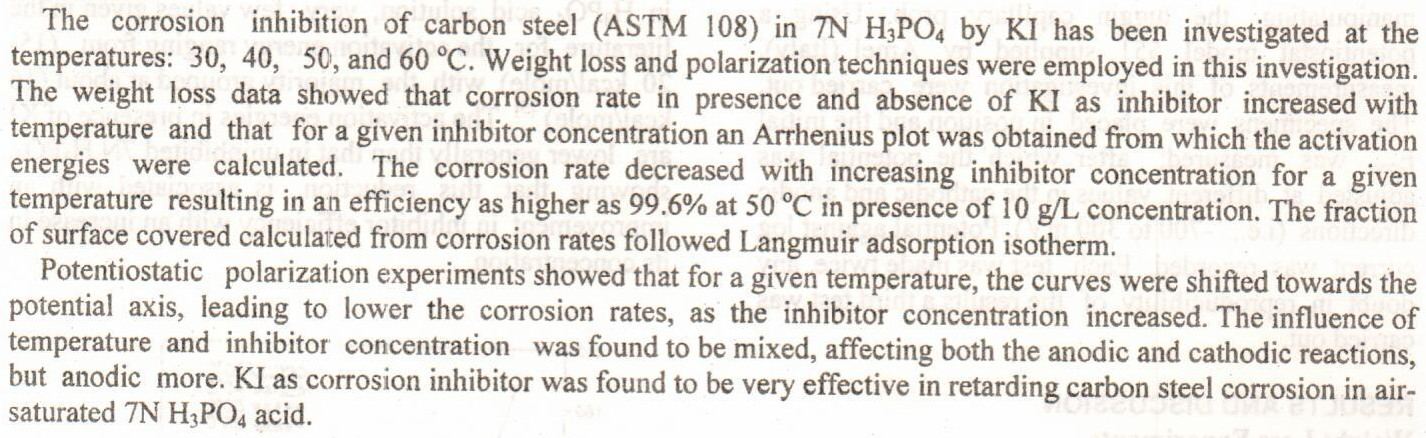
The Influence of Temperature on Corrosion Inhibition of Carbon Steel in Air-Saturated 7NH3PO4 by Potassium Iodide

Materials and Methods Bacterial strains P. aeruginosa was obtained from postgraduate students Laboratories of Biology Department/College of Science/University of Baghdad. That previously isolated from patient suffering from Cystic Fibrosis. API 20 NE system was employed for the identification of P. aeruginosa. A total of 122 urine specimens were collected in the period between of mid of July until to the mid of September of 2010 from AL-Kadhmiya Teaching Hospital in Baghdad City. Specimens were collected from out-patients in sterile screw cupped containers. Regarding inpatients, catheter was withdrawn and cut
Cover crops (CC) improve soil quality, including soil microbial enzymatic activities and soil chemical parameters. Scientific studies conducted in research centers have shown positive effects of CC on soil enzymatic activities; however, studies conducted in farmer fields are lacking in the literature. The objective of this study was to quantify CC effects on soil microbial enzymatic activities (β-glucosidase, β-glucosaminidase, fluorescein diacetate hydrolase, and dehydrogenase) under a corn (Zea mays L.)–soybean (Glycine max (L.) Merr.) rotation. The study was conducted in 2016 and 2018 in Chariton County, Missouri, where CC were first established in 2012. All tested soil enzyme levels were significantly different between 2016 and 2018
... Show More (23)
(23)
 (19)
(19)



The buildup factor was measured after irradiating Iraq carbon black powder using each of and sources respectively, using mixing ratios 40% & 50% for thickness range . The results showed that the buildup factor depends on energy and has limited dependence on the mixing ratio. The QIFT program succeeded accenting for the experimental results even for expected values more than 4 m.f.p outside the thickness range.
The nonlinear refractive (NLR) index and third order susceptibility (X3) of carbon quantum dots (CQDs) have been studied using two laser wavelengths (473 and 532 nm). The z-scan technique was used to examine the nonlinearity. Results showed that all concentrations have negative NLR indices in the order of 10−10 cm2/W at two laser wavelengths. Moreover, the nonlinearity of CQDs was improved by increasing the concentration of CQDs. The highest value of third order susceptibility was found to be 3.32*10−8 (esu) for CQDs with a concentration of 70 mA at 473 nm wavelength.
(1)
Two novel demountable shear connectors for precast steel-concrete composite bridges are presented. The connectors use high-strength steel bolts, which are fastened to the steel beam with the aid of a special locking configuration that prevents slip of bolts within their holes. Moreover, the connectors promote accelerated construction and overcome typical construction tolerances issues of precast structures. Most importantly, the connectors allow bridge disassembly, and therefore, can address different bridge deterioration scenarios with minimum disturbance to traffic flow, i.e. (1) precast deck panels can be rapidly uplifted and replaced; (2) connectors can be rapidly removed and replaced; and (3) steel beams can be replaced, while precast
... Show MoreIn this paper, Response Surface Method (RSM) is utilized to carry out an investigation of the impact of input parameters: electrode type (E.T.) [Gr, Cu and CuW], pulse duration of current (Ip), pulse duration on time (Ton), and pulse duration off time (Toff) on the surface finish in EDM operation. To approximate and concentrate the suggested second- order regression model is generally accepted for Surface Roughness Ra, a Central Composite Design (CCD) is utilized for evaluating the model constant coefficients of the input parameters on Surface Roughness (Ra). Examinations were performed on AISI D2 tool steel. The important coefficients are gotten by achieving successfully an Analysis of V
... Show MoreThis paper reports an experimental study of welding of dissimilar materials between transparent Polymethylmethacrylate (PMMA) and stainless steel 304 sheets using a pulsed mode Nd:YAG laser. The process was carried out for two cases; laser transmission joining (LTJ) and conduction joining (CJ). The former is achieved when the joint is irradiated from the polymer side and the latter when the joint is irradiated from the opposite side (metal side). The light and process parameters represented by the peak power (Pp), pulse duration (τ), pulse repetition rate (PRR), scanning speed (ν) and pulse shape have a significant effect on the joint strength (Fb), joint bead width (b), joint quality and appearance. The optimum parameters were determined
... Show More
(81)
(74)
(2)

(151)
(149)