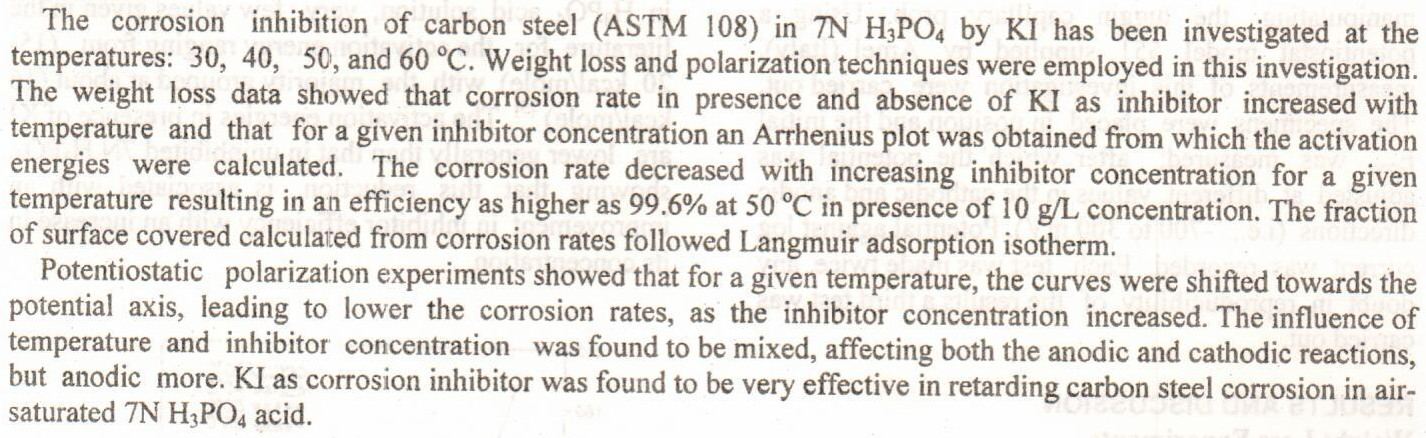
The Influence of Temperature on Corrosion Inhibition of Carbon Steel in Air-Saturated 7NH3PO4 by Potassium Iodide

Strengthening of composite beams is highly needed to upgrade the capacities of existing beams. The strengthening methods can be classified as active or passive techniques. Therefore, the main purpose of this study is to provide detailed FE simulations for strengthened and unstrengthened steel–concrete composite beams at the sagging and hogging moment regions with and without profiled steel sheeting. The developed models were verified against experimental results from the literature. The verified models were used to present comparisons between the effect of using external post-tensioning and CFRP laminates as strengthening techniques. Applying external post-tensioning at the sagging moment regions is more effective because of the e
... Show More (6)
(6)
 (6)
(6)



Abstract:
The current research is aimed at analyzing the impact of the dimensions of Job involvement of all of (the enthusiasm, the Devotion, Assimilation ) in the Crystallize organizational Identification across the dimensions of (organizational loyalty, membership, similarities) and was named the Middle East, the Iraqi Investment Bank room to look as the research community of staff adopted in the bank, to be applied to a Random sample of (100) employees working in the said bank, and developed for the purposes of data collection, a questionnaire form included three axes covered (32) paragraph of the measure, which is included adopted Liekrt Quintet for the
... Show More
This paper has investigated experimentally the dynamic buckling behavior of AISI 303 stainless steel Aluminized and as received long columns. These columns, hot-dip aluminized and as received, are tested under dynamic buckling, 22 specimens, without aluminizing (type 1), and 50 specimens, with hot-dip aluminizing at different aluminizing conditions of dipping temperature and dipping time (type 2), are tested under dynamic compression loading and under dynamic combined loading (compression and bending) by using a rotating buckling test machine. The experimental results are compared with Perry Robertson interaction formula that used for long columns. Greenhill formula is used to get a mathematical model that descripts the buckling behavior
... Show More
(17)
(15)
Objective: the objective of this study was to compare the intraoperative blood loss, intraoperative time, postoperative pain and secondary hemorrhage between electrodissection and cold steel dissection tonsillectomy.
Methods: One hundred and six patients were enrolled in this study, the patients were randomly allocated into electrodissection group A (n=51) and cold steel dissection tonsillectomy group B (n=53). All patients are above 7 years and had history of recurrent tonsillitis and/or tonsillar hypertrophy with obstructive symptoms. Intraoperative parameters and postoperative outcome were assessed.
Results: In group A patients had statically significa
... Show More
Heat pipes and two‐phase thermosyphon systems are passive heat transfer systems that employ a two‐phase cycle of a working fluid within a completely sealed system. Consequently, heat exchangers based on heat pipes have low thermal resistance and high effective thermal conductivity, which can reach up to the order of (105 W/(m K)). In energy recovery systems where the two streams should be unmixed, such as airconditioning systems of biological laboratories and operating rooms in hospitals, heat pipe heat exchangers (HPHEs) are recommended. In this study, an experimental and theoretical study was carried out on the thermal performance of an air‐to‐air HPHE filled with two refrigerants as working fluids, R22 and R407c. The heat pipe he
... Show More
(17)
(17)
The 3D electro-Fenton technique is, due to its high efficiency, one of the technologies suggested to eliminate organic pollutants in wastewater. The type of particle electrode used in the 3D electro-Fenton process is one of the most crucial variables because of its effect on the formation of reactive species and the source of iron ions. The electrolytic cell in the current study consisted of graphite as an anode, carbon fiber (CF) modified with graphene as a cathode, and iron foam particles as a third electrode. A response surface methodology (RSM) approach was used to optimize the 3D electro-Fenton process. The RSM results revealed that the quadratic model has a high R2 of 99.05 %. At 4 g L-1 iron foam particles, time of 5 h, and
... Show More
(2)
(1)
(5)
(2)
Background. Material tribology has widely expanded in scope and depth and is extended from the mechanical field to the biomedical field. The present study aimed to characterize the nanocoating of highly pure (99.9%) niobium (Nb), tantalum (Ta), and vanadium (V) deposited on 316L stainless steel (SS) substrates which considered the most widely used alloys in the manufacturing of SS orthodontic components. To date, the coating of SS orthodontic archwires with Nb, Ta, and V using a plasma sputtering method has never been reported. Nanodeposition was performed using a DC plasma sputtering system with three different sputtering times (1, 2, and 3 hours). Results. Structural and elemental analyses were conducted on the deposited coating
... Show More
(11)
(8)
Granular carbon can be used after conventional filtration of suspended matter or, as a combination of filtration - adsorption medium. The choice of equipment depends on the severity of the organic removal problem, the availability of existing equipment, and the desired improvement of adsorption condition.
Design calculations on dechlorination by granular - carbon filters considering the effects of flow rate, pH , contact time, head loss and bed expansion in backwashing , particle size, and physical characteristics were considered assuming the absence of bacteria or any organic interface .