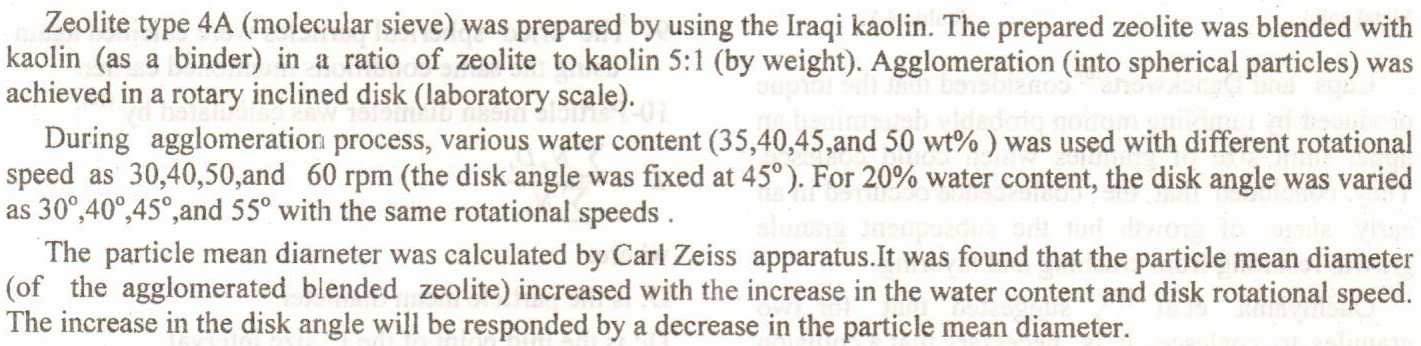
Preparation of Zeolite 4A and Studying the Operating Conditions of the Agglomeration in the Inclined Rotary Disk

the history of the Scouting movement reflects the global social cultural and technological change over more than a century. scouting aims to develop young people worldwide through educational programs based on specific principles and values. in arab countries, the scouting movement is considered one of the most important platforms contributing to developing young people and enhancing their rule. positive in society, began with the establishment of the first Scout camp in the region and witnessed great growth and prosperity over the decades the research reveals the historical roots and development of the scout movement in the leading arab countries and analyzes the positive impact of scout movement in the leading arab countries on the develo
... Show Moreفي البداية اود الاشارة الى ان فهم حقيقة الازمة هو ذو جانب فني يتعلق بالجينات الوراثية لنظام يملك في احيناته قدرة عالية على تفريخ المشتقات. هذا النظام الذي يزداد عقما وتدميرا يزداد قدرة على خلق النقود الائتمانية/المشتقات، وكلما اقتربنا اكثر من فهم هذا الجانب كلما اسقطت في ايدينا تلك التوصيفات الاكاديمية الجاهزة في نقص الرقابة والاشراف، تركيز المخاطر،....الخ التي تناولتها الكتابات الشائعة في معظم طروحات
... Show More
الخلاصة
تعد الانتخابات بمثابة الطريق المؤدي إلى الديمقراطية كونها النمط الأكثر شيوعاً لمشاركة المواطنين في الحياة السياسية للبلدان واختيار ممثليهم في المجالس التشريعية، حيث أن مطلب إجراء انتخابات حرة ونزيهة لم يعد مطلباً داخلياً فحسب بل مطلباً دولياً يصرّ المجتمع الدولي على الوفاء به وهذا يلقي على عاتق كل دولة أن تضع من الضمانات ما يكفل ممارسة هذه الانتخابات ب
... Show More
Forensic accounting (FA) is an important tool in exposing financial manipulation and corruption within institutions, making the role of FA essential in the Iraqi judicial system (IJS). This role suffers from limited implementation due to the lack of specialized legislation and insufficient awareness of its importance. The role of FA in the IJS can be enhanced by enhancing professional training, amending university curricula to include FA, and developing legislation regulating this field. Furthermore, cooperation between courts and the FA should be strengthened to ensure adequate financial evidence (FE) in judicial cases. For example, the experiences of developed countries, such as the United States and the United Kingdom, demonstrate how FA
... Show More
The present research aims at identifying the effect of the cognitive discrepancy strategy on the fourth-stage students’ achievement in literature and texts. The researcher adopted the null hypothesis: there is no statistically significant difference at the level (0.05) between the average grades of the experimental group who study literature and texts following the discrepancies strategy, and those who follow the traditional method. A post-achievement test of (60) paragraphs was administered to (6) students as the study sample. The results showed that the experimental group who studied literature and texts with the strategy of cognitive achieved better than the control group who followed the traditional method in the post-achievement t
... Show MoreAbstract
The image of the soldier, as a hero who sacrifices everything to defend his
country and values, is no longer depicted in modern drama. With two World Wars
and many regional wars and civil wars, the soldier becomes a victim, not a hero.
Authors present the character of the soldier as a man who suffers a lot as he is
victimized by his own government and its politics that forces him to be in such a
position. Dramatists express their views about race, oppression and war through
their characters, such as the character of the soldier, as in the two selected plays for
this research: The Hostage by Brendan Behan and A Soldier's Play by Charles
Fuller.
The Hostage depicts, through its events, the Irish oppre
The study of triples seeks to deal with the comprehensive nature of the Qur’an texts, and the choice fell on the trilogy of great torment, pain, and humiliation in the Noble Qur’an - an objective study, the title of this research, in which I tried to shed light on these terms, and the nuances between them, and in particular torment The eschatological terminology varied, which can be summed up in three terms, namely the great, the painful, and the offensive. The types of torment, the pain is the painful one that is described by the severity of pain and its horror, as for the humiliating punishment, it is that which humiliates the one who has fallen on it, and the diversity of torment is due to the diversity of sins.
This research aims to measure the discrepancy between the accounting income which is prepared according to generally accepted accounting principles and the tax income that is being prepared according to the rules and tax laws, and find out the most important differences that arise between incomes.The research found the most important to the following conclusions:1.Faces determining the tax base for companies subject to income challenges related to the weakness of the efficiency and the possibility of technical angel tax and its ability to examine the financial statements submitted to the tax administration tax.2.That the tax system in Iraq does not comply with accepted accounting principles generally accepted.The research recommends the
... Show More
The research section tagged (Aesthetics of Abstract Expressionism and its Representations in the Artistic Products of Students of the Department of Art Education) into four chapters and it included in..
The first chapter: (the methodological framework) for the research, and the research problem is summarized through the question (what are the aesthetics of abstract expressionism and its representations in the artistic productions of the students of the Department of Art Education). In the products of students of the Department of Art Education).
The aim of the research was (discovering the aesthetics of abstract expressionism and its representations in the artistic products of the students of the Department of Art Education). As we
The Risks Faced by Britain in their Areas of Influence at the Beginning of the Twentieth Century Drove her to the Alliance with the State of European such as France, and Contributed to the Tireless and made by the British and French Politicians in the Consolidation of Friendly Relations between the two Countries Efforts and Strengthened Cooperation in a Positive Way to Visit the king of Britain's Edward VII to France, Offset by Visit French President Loubet to Britain in the Same Year, those Negotiations Bore Fruit between the two Countries for Reaching a Contract Arbitration and Decisiveness between Britain and France Treaty on the Fourteenth of November 1903, Promised that Treaty First Step that Paved the Way for a General Agreement be
... Show More