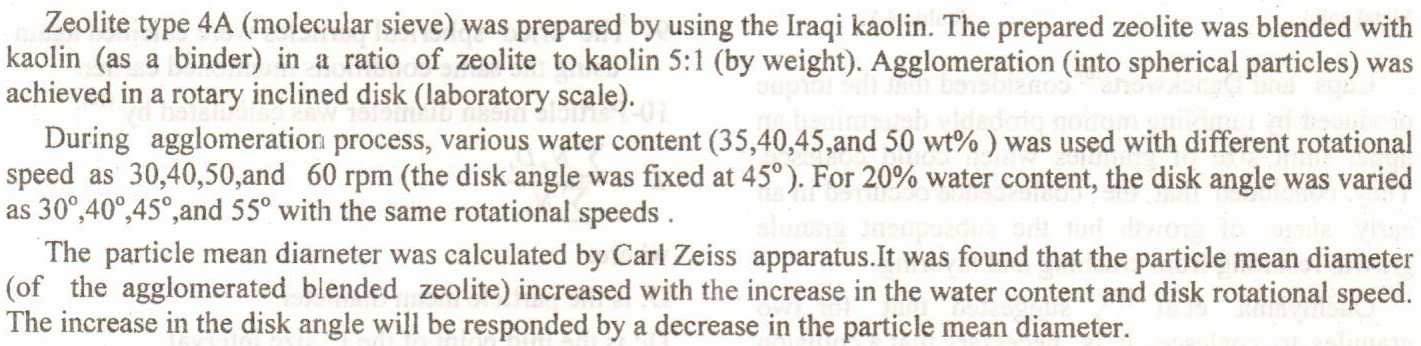
Preparation of Zeolite 4A and Studying the Operating Conditions of the Agglomeration in the Inclined Rotary Disk

Safety programmes are considered one of the means to protect workers from different accidents and injuries and also to protect all assets including machines equipment and various materials. In spite of world state interests in occupational safety, this subject didn't get the required attention by senior staff of management at most of our country construction factories and the application of safety programmes still limited and in active. In order to a achieve the goal of the study, scientific method has been pursued to obtain the necessary information related to this study through tours to related companies and their construction factories and review literature that deal with occupational safety subject and their programmes and cost, in a
... Show MoreIn this paper, a description of a design for new DES block cipher, namely DES64X and DES128X. The goals of this design, a part of its security level, are large implementation flexibility on various operating systems as well as high performances. The high level structure is based on the principle of DES and Feistel schema, and proposes the design of an efficient key-schedule algorithm which will output pseudorandomsequences of subkeys. The main goal is to reach the highest possible flexibility, in terms of round numbers, key size, and block size. A comparison of the proposed systems on 32-bit, 64-bit operating system, using 32-bit and 64-bit Java Virtual Machine (JVM), showed that the latter has much better performance than the former.
... Show MoreBy- products of corn starch industry were used to prepare media for propagation the lactic acid bacteria as a natural auxotroph. The by- products used were the corn steep water (S) and gluten extract (G) after a proper treatment to get them ready for media preparation. The results showed that it was possible to replace the peptone and meat extract by gluten extract in MRS medium. The growth was approximately similar to that obtained in standard MRS media. Corn steep water (S) was used as well and the growth enhanced by including Tween – 80 at 1% level. The later media named MZ, which was superior for growing standard and local strains and starters. The MZ medium modified by adding acetate and glacial acetic acid similarly to
... Show More
Earth dams are constructed mainly from soil. A homogenous earth dam is composed of only one material. The seepage through such dams is quite high. Upstream impervious blanket is one of the methods used to control seepage through the dam foundations. Bennet's method is one of the commonly used methods to design an impervious upstream blanket. Design charts are developed relating the length of blanket, total reservoir head, total base width of the dam (excluding downstream drainage), the coefficient of permeability of the blanket material, blanket thickness, foundation thickness, and coefficient of permeability of the foundation soil, based on the equations governing the Bennet's method for a homogenous earth dam with a blanket of uniform
... Show More
In this study, the photodegradation of Congo red dye (CR) in aqueous solution was investigated using Au-Pd/TiO2 as photocatalyst. The concentration of dye, dosage of photocatalyst, amount of H2O2, pH of the medium and temperature were examined to find the optimum values of these parameters. It has been found that 28 ppm was the best dye concentration. The optimum amount of photocatalyst was 0.09 g/75 mL of dye solution when the degradation percent was ~ 96 % after irradiation time of 12 hours, while the best amount of hydrogen peroxide was 7μl/75 mL of dye solution at degradation percent ~97 % after irradiation time of 10 hours, whereas pH 5 was the best value to carry out the reaction at the highest degradation percent. In additio
... Show More (20)
(20)
 (13)
(13)

 (2)
(2)
In this study, the photodegradation of Congo red dye (CR) in aqueous solution was investigated using Au-Pd/TiO2 as photocatalyst. The concentration of dye, dosage of photocatalyst, amount of H2O2, pH of the medium and temperature were examined to find the optimum values of these parameters. It has been found that 28 ppm was the best dye concentration. The optimum amount of photocatalyst was 0.09 g/75 mL of dye solution when the degradation percent was ~ 96 % after irradiation time of 12 hours, while the best amount of hydrogen peroxide was 7μl/75 mL of dye solution at degradation percent ~97 % after irradiation time of 10 hours, whereas pH 5 was the best value to carry out the reaction at the highest degradation percent. In additio
... Show More
(20)
(13)
In this study, the photodegradation of Congo red dye (CR) in aqueous solution was investigated using Au-Pd/TiO2 as photocatalyst. The concentration of dye, dosage of photocatalyst, amount of H2O2, pH of the medium and temperature were examined to find the optimum values of these parameters. It has been found that 28 ppm was the best dye concentration. The optimum amount of photocatalyst was 0.09 g/75 mL of dye solution when the degradation percent was ~ 96 % after irradiation time of 12 hours, while the best amount of hydrogen peroxide was 7μl/75 mL of dye solution at degradation percent ~97 % after irradiation time of 10 hours, whereas pH 5 was the best value to carry out the reaction at the highest deg
... Show More
(20)
(13)