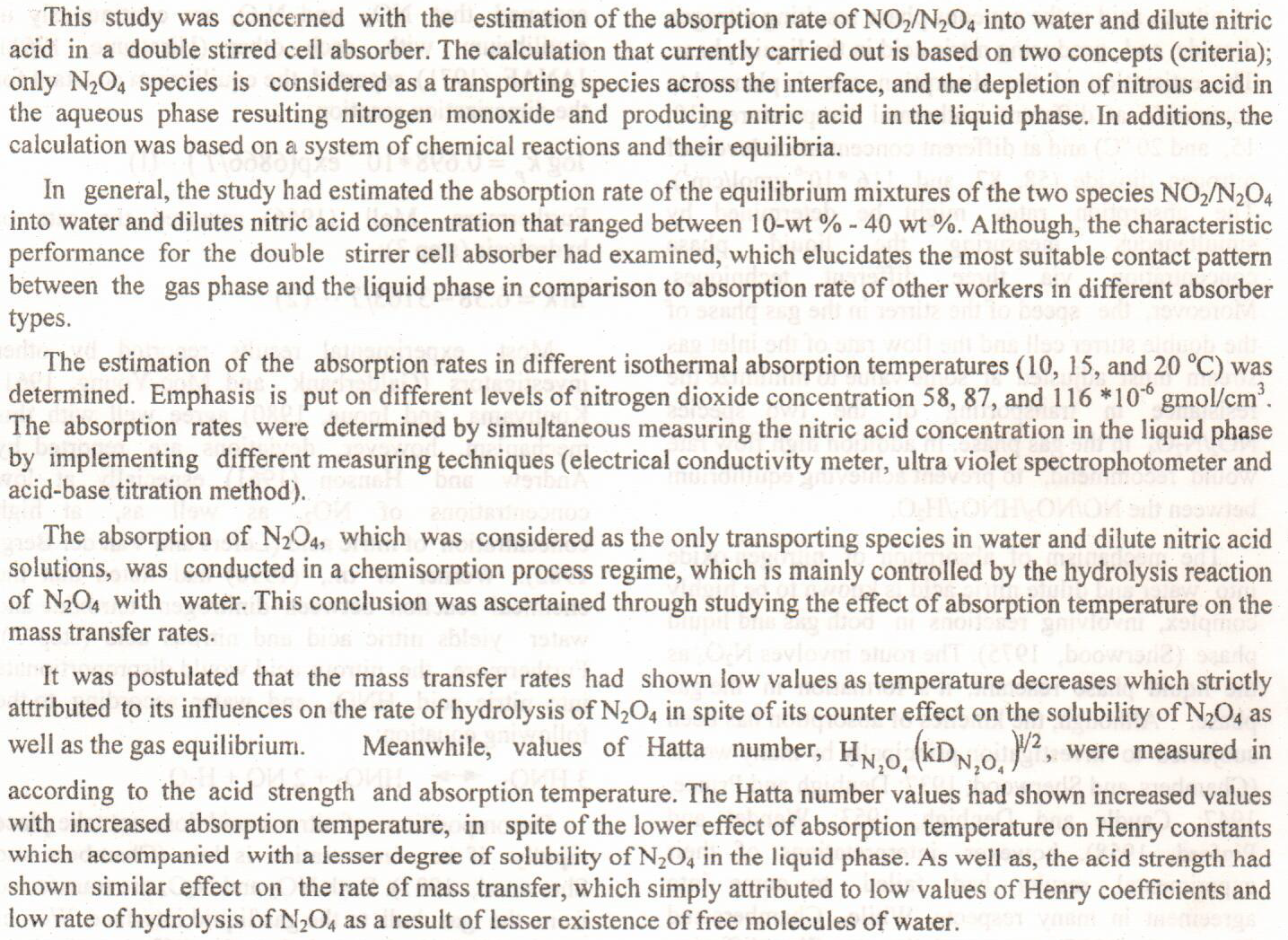
Adsorption of NO2/N2O4 into Water and Dilute Nitric Acid in a Double Stirrer Adsorber

A factorial experiment was applied with four replicates on rosemary plants (Rosmarinus officinalis L.) grown in pots inside the glasshouse of the Department of Biology, College of Science, Salahaddin University, Erbil, Iraq, during April, 2019 to July, 2020, to determine the effects of soil moisture content ( SM1: 100% and SM2: 60% field capacity), nitrogen fertilizer (N1: 100, N2: 200 and N3: 300kg/hectare), and magnesium fertilizer (Mg1: 0.0, Mg2: 30 and Mg3: 60kg/hectare) and their interactions on some growth characteristics and essential oil content of rosemary plants. Two cuttings were taken from rosemary shoots (on March, 2020 and July, 2020) after 12 and 15 months of planting respectively. Results showed that cutting 1:
... Show More (1)
(1)
 (1)
(1)


PVC/Kaolinite composites were prepared by the melt intercalation method. Mechanical properties, thermal properties, flammability and water absorption percentage of prepared samples were tested. Mechanical characteristic such as tensile strength, elongation at break; hardness and impact strength (charpy type) were measured for all samples. It was found that the tensile strength and elongation at break of PVC composites decreased with increasing kaolinite loading. Also, the hardness of the composites increases with increase in filler content .The impact strength of the composites at the beginning increases at lower kaolinite loadings is due to the lack of kaolin adhesion to the matrix. However, at higher kaolin loadings. This severe agglom
... Show MoreTwo years field experiment was carried out at Agricultural Fields, College of Agriculture, Baghdad University, Al-Jadriya during 2014-2015 and 2015-2016 to determine the effect of salinity of irrigation water on growth and grain yield of three oat cultivars. The experiments were laid out according to randomized complete blocks design having split plot arrangements with two factors; first factor included three oat cultivars (Shifaa, Hamel and Pimula) while the second factor included three levels of salinity of irrigation water (3, 6 and 9 dS.m-1 ) in addition to the control (river water with salinity level of 1.164 dS.m-1 ) with three replicates. Results revealed a significant effect of salinity of irrigation water on all studied traits. Mea
... Show MoreDuring the study the current selection seven stations in the Zab River bottom and the Tigris River took samples a month to study the signs of bacterial contamination study coliform and colon fecal Almsobhaat and Almsobhaat Bazah and the total number of bacteria and bacterial gangrene gas causing Knkeran as well as a study to isolate and diagnose some races and types of bacterial pathogens in water or intensityusing the traditional system and the system of intestinal bacteria
The aim of this work is to evaluate some mechanical and physical
properties (i.e. the impact strength, hardness, flexural strength,
thermal conductivity and diffusion coefficient) of
(epoxy/polyurethane) blend reinforced with nano silica powder (2%
wt.). Hand lay-up technique was used to manufacture the composite
and a magnetic stirrer for blending the components. Results showed
that water had affected the bending flexural strength and hardness,
while impact strength increased and thermal conductivity decreased.
In addition to the above mentioned tests, the diffusion coefficient
was calculated using Fick’s 2nd law.
(3)
تم تحضير ثلاث معقدات جديدة Ni (II)و Cu (II) و Zn (II) باستخدام الليكند المحضر الجديد من تفاعل حامض مالونيك ثنائي هيدرازايد مع 2-بيريدين كربوكسالديهايد. حيث شخصت المعقدات لمحضرة وكذلك الليكند باستخدام تقنيات مختلفة مثل FT-IR و UV-Vis و Mass و 1H-NMR و 13C-NMR وتحليل العناصر CHN و تقدير محتوى الكلور والموصلية المولارية والحساسية المغناطيسية والامتصاص الذري لتشخيص هذه المركبات. لكل معقد محضر جديد من النيكل والنحاس والزنك ، كشفت نتائج ا
... Show More
(6)
(1)

In the coming decade, a substantial rise in energy consumption within the buildings sector is predicted to lead to a 30% increase in greenhouse gas emissions. The choice of materials for building envelopes significantly influences the overall energy demand of HVAC systems, which contribute significantly to electricity usage. To enhance compatibility between grey clay and straw, a suggested approach involves using a composite material comprising rice water and grey clay, enriched with a high proportion of rice straw and soaked in rice water. This environmentally friendly technique yields a green construction material capable of reducing energy consumption in HVAC systems by up to 35.6% over a 24-h period. The potential energy savings of this
... Show More
(4)
(5)
tA novel synthesis procedure is presented for preparing triethanolamine-treated graphene nanoplatelets(TEA-GNPs) with different specific areas (SSAs). Using ultrasonication, the covalently functionalizedTEA-GNPs with different weight concentrations and SSAs were dispersed in distilled water to prepareTEA-GNPs nanofluids. A simple direct coupling of GNPs with TEA molecules is implemented to synthesizestable water-based nanofluids. The effectiveness of the functionalization procedure was validated by thecharacterization and morphology tests, i.e., FTIR, Raman spectroscopy, EDS, and TEM. Thermal conduc-tivity, dispersion stability, and rheological properties were investigated. Using UV–vis spectrometer, ahighest dispersion stability of 0.876
... Show More
(95)
(8)
A field experiment was conducted to grow the wheat crop during the fall season 2020 in Karbala province, north of Ain Al-Tamr District in two locations of different textures and parent materials. The first site (calcareous soil) with a sandy loam texture, is located at (44° 40′ 37′) east longitude and (32° 41′ 34′) north latitude, at an altitude of 32 m above sea level, and an area of 20 hectares. As for the second location (gypsum soil) with a loam texture, it is located at a longitude (45° 41′ 39′) east and a latitude (33° 43′ 34′ north) and at an altitude of 33 m above sea level and an area of 20 hectares. To find out the effect of different tillage systems on water productivity and wheat yield under center pivot irri
... Show More
(6)
(1)