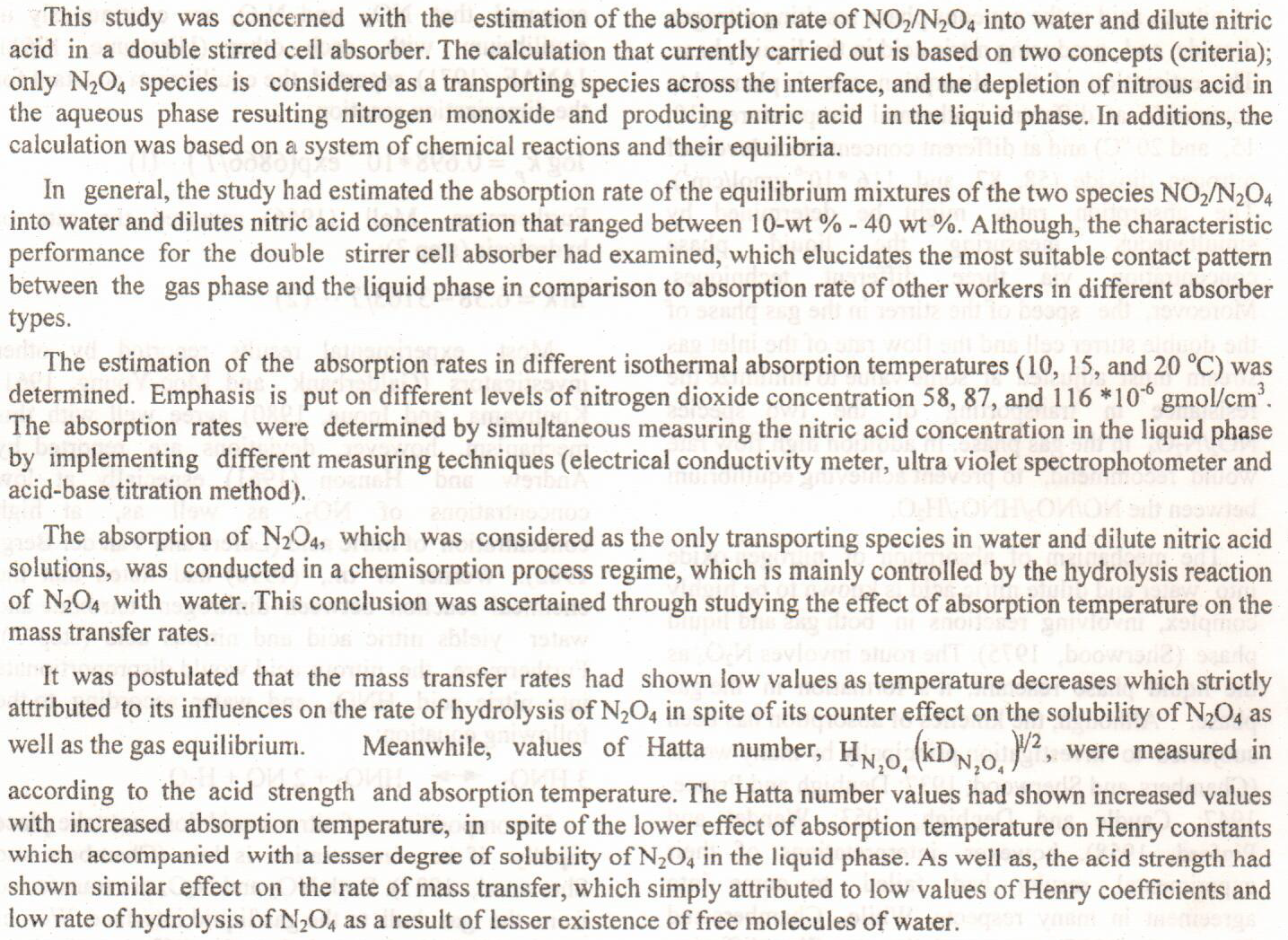
Adsorption of NO2/N2O4 into Water and Dilute Nitric Acid in a Double Stirrer Adsorber

Thsst researcher problem of delays faced by researchers are all waiting to evaluate their standards by the experts who must take their views to extract the truth Virtual important step first step in building standards whatsoever, then the difference of opinion among experts about the paragraphs Whatever the scope of their functions, leading to confusion in maintaining these paragraphs or delete? Or ignore the views and opinion of the researcher to maintain the same? Or as agreed upon with the supervisor if he was a student? Especially if the concepts of a modern new building.
Therefore, the researcher sought to try to find a solution to her problem to conduct an experiment to test building steps
this study aimed to study the effect of Cordia myxa extract on the growth and activities of the following types of bacteria : Escherichia coli , Pseudomonas aeruginosa, Proteus Spp., Klebsiella pneumoniae , Staphylococcus aureus, Streptococcus pyogenes , Bacillus subtilus, and the yeast Candida albicans .the results showed an inhibitory effect of the methanol extract on both the growth and activity of the tested microbes .this was reflected by the minimum inhibitory concentration ( MIC ) of different type of bacteria and the yeast.
 (1)
(1)

Two field experiments were carried out for cultivating yellow maize crop Zea mays L. during the autumn planting season 2019 in two sites with soils of different textures. The first site is a loamy texture in one of the fields of the Medhatia Agriculture Division, Babylon Governorate. The second was silty loam by an alluvial mixture in one of the fields of Al-Nouriah Research Station, Ministry of Agriculture located in Al-Nouriah sub-district, Al-Qadisiyah governorate. It was found through the results that the uniformity, efficiency, and adequacy of the irrigation efficiency of the sprinkler irrigation method is better than that of the sprinkler irrigation method, and it ranged between (88.6-88.7) for uniformity and (84-86)% of the irrigatio
... Show More (17)
(17)

Biodegradation is utilizing microorganisms to degrade materials into products that are safe for the
environment, such as carbon dioxide, water, and biomass. The current study aims to isolate and characterize
bacteria with polyethylene terephthalate (PET) degradation ability isolated from Shatt al-Arab water and
sewage from Basra, the bacteria were identified as Klebsiella pneumonia. According to the findings, the
isolates showed a highly significant difference in degradation of PET (24% during 7 days) and the percent of
degradation increased to 46% at 4 weeks compared to the control. The study also involved determining the
optimum temperature of K. pneumonia growth, which was 37°C, while the preferred
(5)
(9)
The agricultural lands that depend on supplementary irrigation methods for winter wheat cultivating in wide areas of the Nineveh province are most vulnerable to climate change concerns. Due to frequent rainfall shortages and the temperature increase recently noticed and predicted by the climate scenarios. Hence important to assess the climate effect on the crop response in terms of water consumption during the periods (2021-2040) and (2041-2060) by using high-resolution data extracted from 6 global climate data GCMs under SSP5-8.5 fossil fuel emission scenarios in changing and fixed CO2 concentration. And validate the Aqua-Crop model to estimate the yield and water productivity. And gives the RRSME of 7.1- 4.1
... Show More
(3)
(2)
In this study, biodiesel was prepared from chicken fat via a transesterification reaction using Mussel shells as a catalyst. Pretreatment of chicken fat was carried out using non‐catalytic esterification to reduce the free fatty acid content from 36.28 to 0.96 mg KOH/g oil using an ethanol/ fat mole ratio equal to 115:1. In the transesterification reaction, the studied variables were methanol: oil mole ratio in the range of (6:1 ‐ 30:1), catalyst loading in the range of (9‐15) wt%, reaction temperature (55‐75 °C), and reaction time (1‐7) h. The heterogeneous alkaline catalyst was greenly synthesized from waste mussel shells throughout a calcin
... Show More
(6)
(4)

In this study, biodiesel was prepared from chicken fat via a transesterification reaction using Mussel shells as a catalyst. Pretreatment of chicken fat was carried out using non‐catalytic esterification to reduce the free fatty acid content from 36.28 to 0.96 mg KOH/g oil using an ethanol/ fat mole ratio equal to 115:1. In the transesterification reaction, the studied variables were methanol: oil mole ratio in the range of (6:1 ‐ 30:1), catalyst loading in the range of (9‐15) wt%, reaction temperature (55‐75 °C), and reaction time (1‐7) h. The heterogeneous alkaline catalyst was greenly synthesized from waste mussel shells throughout a calcin
... Show More
(6)
(4)
Effects of Ozonated Water on Micro Leakage between Enamel and Fissure Sealants Prepared by Different Etching Technique (An in vitro Study), Baraa M Jabar*, Muna S Khalaf