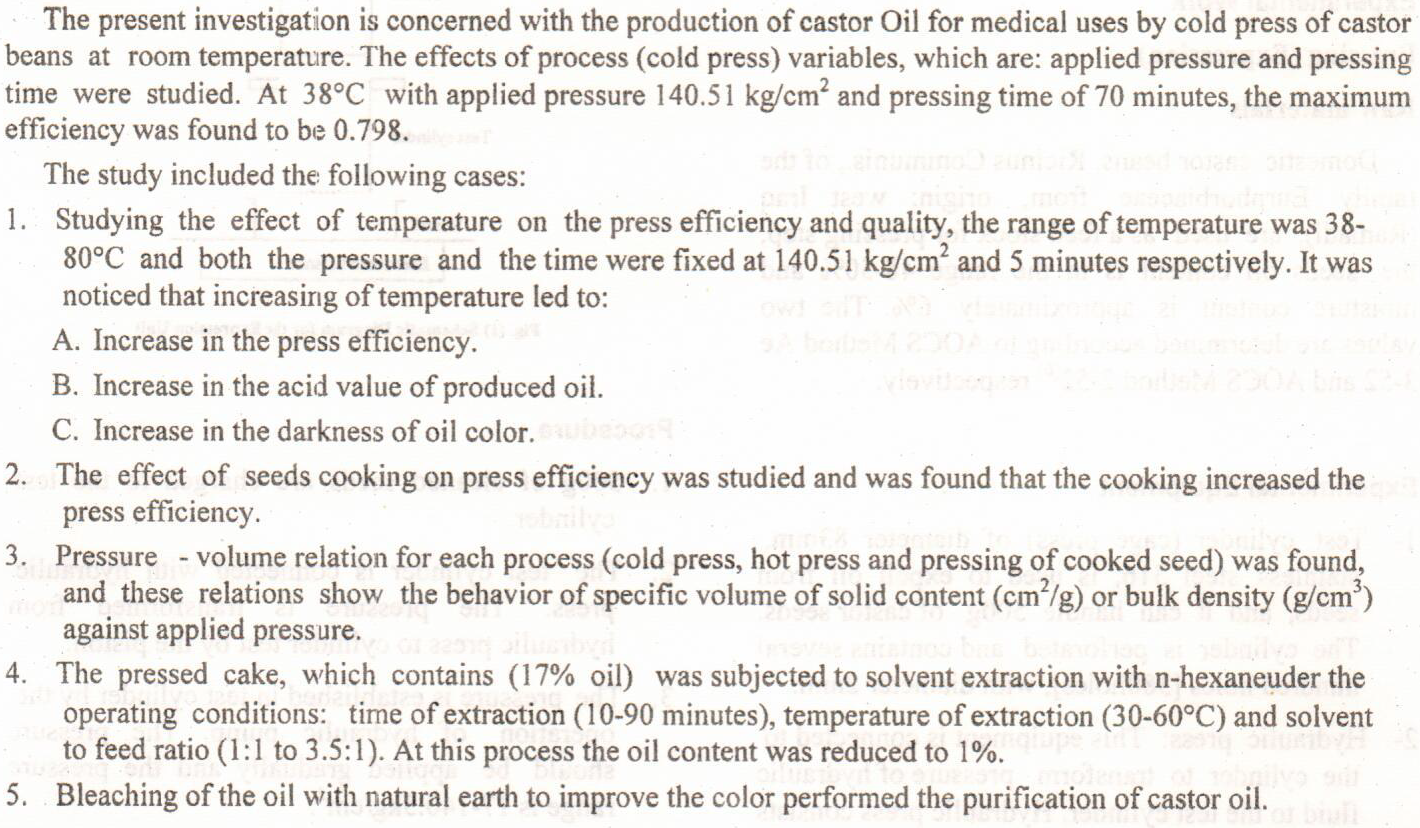
Production of Castor Oil for Medical Uses

Several toxigenic cyanobacteria produce the cyanotoxin (microcystin). Being a health and environmental hazard, screening of water sources for the presence of microcystin is increasingly becoming a recommended environmental procedure in many countries of the world. This study was conducted to assess the ability of freshwater cyanobacterial species Westiellopsis prolifica to produce microcystins in Iraqi freshwaters via using molecular and immunological tools. The toxigenicity of W. prolifica was compared via laboratory experiments with other dominant bloom-forming cyanobacteria isolated from the Tigris River: Microcystis aeruginosa, Chroococcus turigidus, Nostoc carneum, and Lyngbya sp. signifi
... Show More (6)
(6)



Roller compacted concrete (RCC) is a special type of concrete with zero or even negative slump consistency. In this work, it had aimed to produce an RCC mix suitable for roads paving with minimum cost and better engineering properties so, different RCC mixes had prepared i.e. (M1, M2, M3, and M4) using specified percentages of micro natural silica sand powder (SSP) as partial replacement of (0%, 5%, 10%, and 20%) by weight of sulfate resistant Portland cement. Additionally, M-sand, crushed stone, filler, and water had been used. The results had obtained after 28 days of water curing. The control mix (M1) had satisfied the required
(1)
 (1)
(1)
The present study aims to detection optimal conditions of production of amylase enzyme from isolate of B. subtillis A4. Nine carbonic sources were represented by starch, maltose, fructose, sucrose, glucose, arabinose, xylose, sorbitol and mannitol) at concentration of 1% for each source. It was found that the best was represented by starch carbonic, which showed higher activity and qualitative activity of 7.647 Unit/ ml and 461.56 Unit/ mg. Ten nitrogen sources were selected, including yeast extract, peptone, trypton, gelatin, urea and meat extract as organic sources Ammonium sulphate, Sodium nitrate, Potassium nitrate and Ammonium chloride as inorganic sources. These sources were added at aconcentration of 0.5% to the production medium. Th
... Show More
(2)
Four local hemolysin producer bacterial isolates were selected, tow of them gram negative bacteria (Escherichia coli ,Pseudomonas aeruginosa ) and the other two were gram positive bacteria (Staphylococcus aureus , Bacillus cereus ). Minimum inhibitory concentration of the aqueous and alcoholic extracts of Punica granatum L. pericarp were determined towards the four bacterial isolates ,results obtaind showed that MICs of the aqueous extract were 200 mg/ml for E .coli and P. aeruginosa isolates while were 5 mg/ml and 2 mg/ml for B. cereus, S. aureus , respectively The MICs for the ethanolic extract were 50 mg/ml , 20 mg/ml ,1 mg/ml ,0.5 mg/ml for E. coli ,P. aeruginosa ,B. cereus ,S. aureus , respectively. The effect of Sub-MICs o
... Show More
production of the spot in the news channels - a study of patterns of spot media used in the production of spring breaks Arab Al-Arabiya
The spacers news in Arabic, one of the messages that seek channel output are fit and policy on the one hand and meet the needs of viewers for information intensive and image influential to find out the latest developments on the Arab arena, especially the Syrian revolution on the other and thus The viewer for the type of coverage the stomach through a newsletter about the event on the one hand to keep following up on her and eager to watch the other hand
And sou
... Show More
(1)
(3)
(30)
(25)
This experiment was performed to investigate the influence of different oils in the diets of laying quail on their egg quality characteristics. One hundred and twenty 7-wk old Japanese quails (Coturnix coturnix japonica) were allocated to four groups with three replicates containing 10 quail each (30 quail per each treatment group). They were fed for 13 weeks (including one week of adaptation period) on diets containing 3% oil from different sources, viz. either sunflower (T1), linseed (T2), maize (T3), or fish oil (T4). Inclusion the diet of laying quail with fish oil (T4) and maize oil (T2) resulted in significant increase with respect to egg weight, yolk weight, albumen weight, yolk diameter, yolk height, albumen diameter, albumen height
... Show More
(5)
(4)
This experiment was performed to investigate the influence of different oils in the diets of laying quail on their egg quality characteristics. One hundred and twenty 7-week-old Japanese quails (Coturnix coturnix japonica) were allocated to four groups with three replicates containing 10 quail each (30 quail per treatment group). They were fed for 13 weeks (including one week of adaptation period) on diets containing 3% oil from different sources, viz., sunflower (T1), linseed (T2), maize (T3), or fish oil (T4). Inclusion of the diet of laying quail with fish oil (T4) and maize oil (T2) resulted in a significant increase with respect to egg weight, yolk weight, albumen weight, yolk diameter, yolk height, albumen diameter, albumen height, sh
... Show More
(5)
(4)
Abstract Background: The lifestyle of an individual significantly influences health-promoting behaviors. The World Health Organization defines health promotion as a mechanism enabling people to increase control over and improve their health. This study aimed to evaluate the health promoting lifestyle profile of medical staff working in primary health care centers of Al-Rusafa, Baghdad.