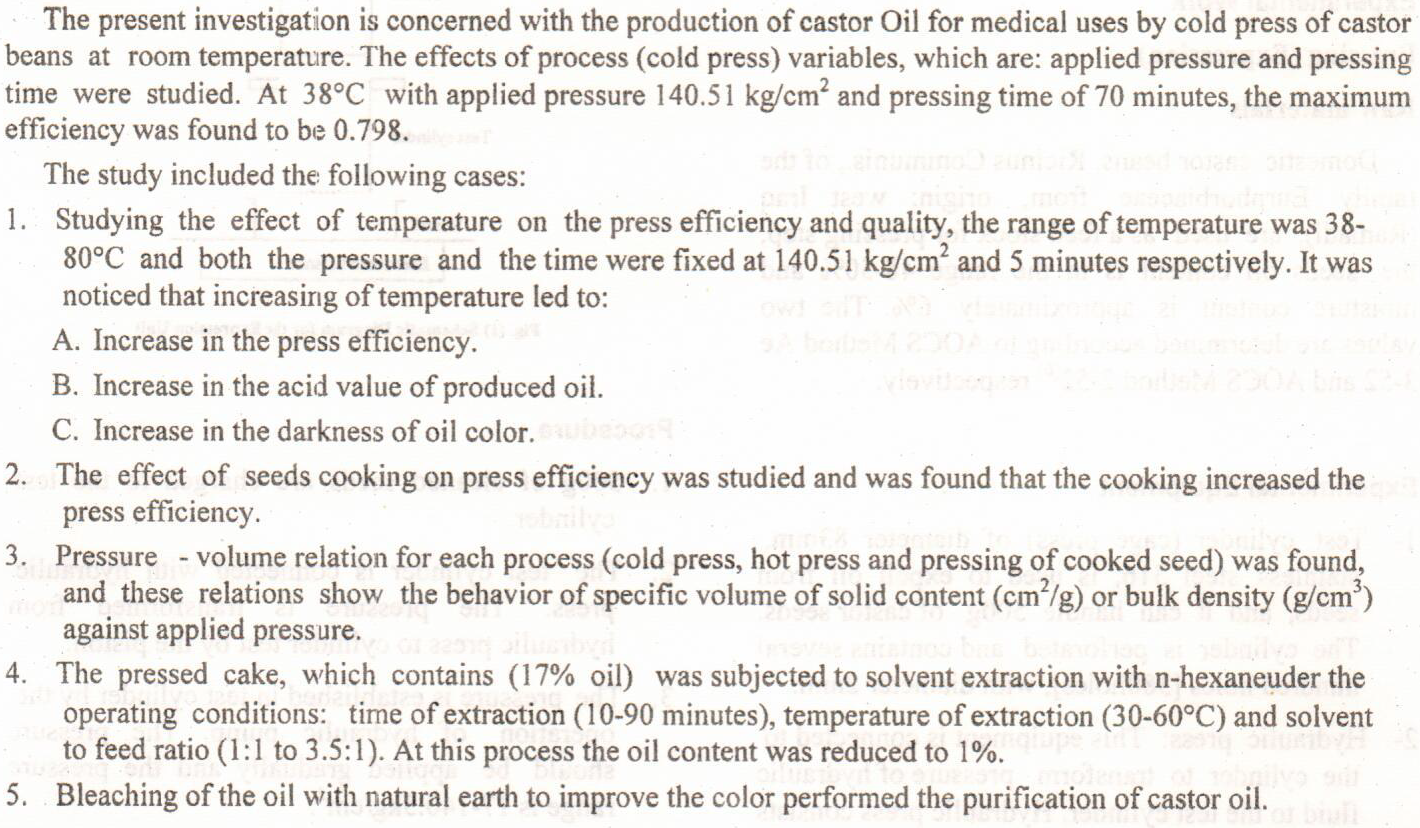
Production of Castor Oil for Medical Uses

Surgical site infections are the second most common type of adverse events occurring in hospitalized patients. Surgical antibiotic prophylaxis refers to the use of preoperative and postoperative antibiotics to decrease the incidence of postoperative wound infections. The objective of this study was to evaluate the antibiotic administration pattern for surgical antibiotic prophylaxis and the adherence to American Society of Health-System Pharmacists surgical antibiotic prophylaxis guideline in Medical City Teaching Hospitals/Baghdad. The medical records of one hundred patients who underwent elective surgical procedures were reviewed. Adherence to the recommendations of American society of health‑system pharmacists guideline was ass
... Show More (1)
(1)

This research aims to know the reality of succession planning in the researched organization and how it occupies the important jobs in the organization and its readiness for sudden and urgent events that lead to the vacancy of these jobs, and the importance of this research is that it is one of the rare Arab and Iraqi studies and research in this field, as it is one of the first researches It deals with the reality of succession planning in light of the retirement law No. (26) of 2019, and the research problem was the absence of consecutive planning programs and the weak preparation of suitable candidates to face sudden and urgent conditions as replacements for current leaders who occupy the leading and key positions in the depar
... Show More
Three types of medical commercial creams Silvazine, Cinolon Tar and Hydroquinon Domina were incorporated in this study. The medical creams were taken directly and placed uniformly on the glass slide. Each type of pharmaceutical was weighed at 1 mg and dispersed on an area of 1x1 cm. This process ensures same thickness for all samples. The creams were analyzed by using double-beam UV/visible spectrophotometer Metertech SP8001. The absorption spectrum for each of samples was measured against wavelength range of 300–700 nm.
Objective(s) : This study aimed at evaluating the seroprevalence of anti -HCV and studying the
correlation between hemophilia and risk factors for acquiring HCV such as age , marital status &
occupation among hemophilic patients .
Methodology : 210 hemophilic patients in children welfare teaching hospital/medical city/Baghdad–Iraq
(hemophilia center) were investigated using prepared questionnaire and tested for HCV infection, those
were measuring patient’s age, hemophilia types and severity, marital status, residency and history of
previous HCV infection .
Results : Most hemophilic patients were hemophilia A at severe , hemophilia was at age group 20 – 29
years , the majority of patients were unmarried a
 (44)
(35)
(44)
(35)


The performance of a synergistic combination of electrocoagulation (EC) and electro-oxidation (EO) for oilfield wastewater treatment has been studied. The effect of operative variables such as current density, pH, and electrolyte concentration on the reduction of chemical oxygen demand (COD) was studied and optimized based on Response Surface Methodology (RSM). The results showed that the current density had the highest impact on the COD removal with a contribution of 64.07% while pH, NaCl addition and other interactions affects account for only 34.67%. The optimized operating parameters were a current density of 26.77 mA/cm2 and a pH of 7.6 with no addition of NaCl which results in a COD removal efficiency of 93.43% and a specific energy c
... Show More
(44)
(35)
In this study two types of extraction solvents were used to extract the undesirable polyaromatics, the first solvent was furfural which was used today in the Iraqi refineries and the second was NMP (N-methyl-2-pyrrolidone).
The studied effecting variables of extraction are extraction temperature ranged from 70 to 110°C and solvent to oil ratio in the range from 1:1 to 4:1.
The results of this investigation show that the viscosity index of mixed-medium lubricating oil fraction increases with increasing extraction temperature and reaches 107.82 for NMP extraction at extraction temperature 110°C and solvent to oil ratio 4:1, while the viscosity index reaches to 101 for furfural extraction at the same extraction temperature and same
The study of surface hardness, wear resistance, adhesion strength, electrochemical corrosion resistance and thermal conductivity of coatings composed from sodium silicate was prepared using graphite micro-size particles and carbon nano particles as fillers respectively of concentration of (1-5%), for the purpose of covering and protecting the oil distillation towers. The results showed that the sodium silicate coating reinforced with carbon nano-powder has higher resistance to stitches, mechanical wear, adhesive and thermal conductivity than graphite/sodium silicate composite especially when the ratio 5% and 1%, the electrochemical corrosion test confirmed that the coating process of stainless steel 304 lead to increasin
... Show MoreLive the present companies in a competitive business environment going on and try to achieve excellence in their industry through the marketing of their products and achieve greater market share as possible to ensure its continued existence, and perhaps the concept of time production, which confirms, in essence, on the need to reduce inventory to a minimum in the production process as well as the concept of the marketing information system which asserts, in essence, to document all the events that are related to the marketing of the product provided by the production process, together constitute the subject deserves research and investigation as they have raised well-known in the fields of production management and marketing management.
... Show MoreThis study was conducted according to contract with the North Refineries Company-Baiji and deals with the hydrodesulphurization of vacuum gas oil of Kirkuk crude oil, boiling range 611-833 K. A trickle bed reactor packed with a commercial cobalt-molybdenum on alumina catalyst was used. The operating conditions were: temperature range 583-643 K, liquid hourly space velocity range 1.50-3.75 1/h, hydrogen to oil ratio about 250 l/l and pressure kept constant at 3.5MPa.
The results showed that the aromatic content decreased and sulfur removal increased with increasing temperature and decreasing space velocity. The properties (viscosity, density, flash point and carbon residue) of the products decrease with temperature increasing, but the