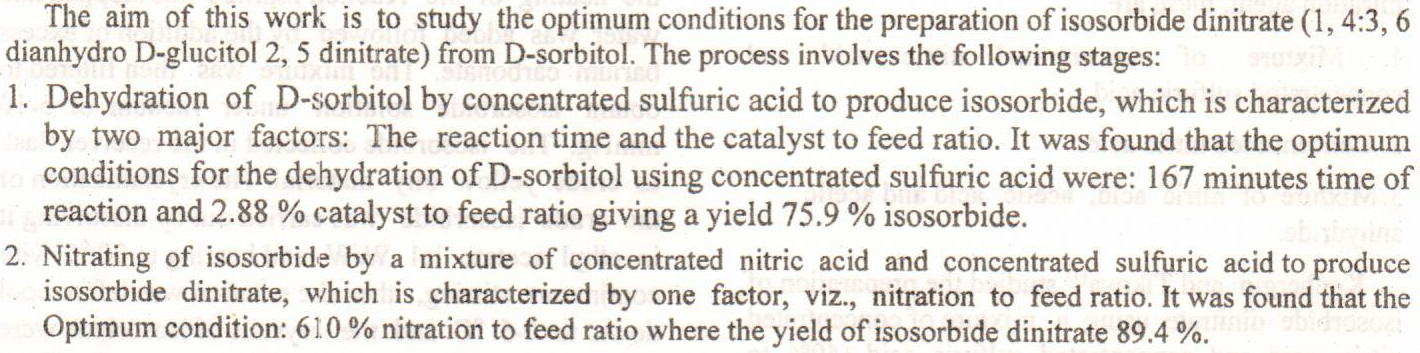
The Preparation of Isosorbide Dinitrate

This study aimed to identify the alterations of liver in the quail (Coturnix coturnix) exposed by nanosilver particles.45 quail (females) were collected from agriculture research center in Abu-Ghraib, divided into (6) groups including: T1(12 quails were exposed to 4ppm), T2 (12 quails were exposed to 8ppm) and T3 (12 quails were exposed to 12ppm) of silver nanoparticles solution for 60 days. As well as three groups for control (3 females for each). Birds were dissected to isolate livers for histological preperations after fixation with Bouin's fluid, Routine stains Hematoxyline and eosin were used. Histological study showed that the structure of liver in a control groups consist of hepatocytes arranged radially cords around the central vein
... Show More
A theoretical study has been proposed to investigate the effects of different laser radiations (Nd - glass, DF and C02) as a heating source on different glass samples (Optical glass, Bk - 7 and Soda - lime glass) and different waves lengths (10.6, 3.8, 1.6) ???. The heat changes as which are resulted due irradiation with laser sources have been determined by using the one dimension mathematical relation as a function of time (t) and depth (z). The results of the study show ed that the irradiation with C02 laser had a greater effect than DF laser, while the effects of Nd - glass laser were minimal with a power density of (1.8*10?? w/m2) within atime(l^sec).(Forboth Kinds) The change in the temperatures were not exceeded than (70"K) in all sa
... Show MoreTwo grades of paving asphalt with penetration of 46 and 65 are studied for determining changes in their physical and chemical properties caused by ageing.
The ageing process has been conducted on two petroleum paving asphalt cement using thin film oven test at 150, 163 and 175 C, and ageing time 5, 10,15, 20, 25 and 30 hours. The effect of ageing time and temperature on penetration, kinematic viscosity, softening point, solubility in trichloroethylene, heat loss and changes in chemical composition are investigated. The results of thin film oven test process indicte that the asphaltenes concentration of all aged asphalt increases with increasing ageing time, while the opposite was observed for polar-aromatic and naphthene-aromatic. The
Sheets of Epoxy (EP) resin with addition of TiO2 of grain size (1.5μm, and 50nm) and weight percentage (1%, 3%, and 5%) were prepared. Discs of 20mm diameter and 3mm thickness were cut for dielectric measurements. Dielectric properties (dielectric constant, dispassion factor and electrical conductivity) over the frequency range 102 -106 Hz were measured.
Comparison was made between the effect of micro and nano particles of TiO2 on the dielectric properties of EP composites with different weight percentage. Epoxy composites with micro sized particles of TiO2 were observed to have the better values of dielectric properties.
Cobalt substituted nickel copper ferrite samples with general formula Ni0.95-xCoxCu0.05Fe2O4, where (x= 0.00, 0.01, 0.02, 0.03, 0.04 and 0.05) were prepared by solid-state reactions method at 1373 K for 4h. The samples prepared were examined by X-ray diffraction (XRD(, atomic force microscope (AFM), Fourier transform infra-red spectroscopy (FTIR) and Vickers hardness. X-ray diffraction patterns confirm the formation of a single phase of cubic spinel structure in all the prepared samples . XRD analysis showed that the increase in the cobalt concentration causes an increase in the lattice constant, bulk density (ρm) and the x-ray density (ρx), whereas porosity (p) and crystallite size (D) decrease. The Topography of the surface observed
... Show More (1)
(1)
EP/ metal composites were prepared as adhesives between two steel rods. Epoxy resin (EP) was used as a matrix with metal as fillers (Al, Cu, Fe,).
The preparation method for tensile adhesion tests includes two steel rods with adhesive composites between the rods to measure adhesion strength Sad and adhesion toughness Gad.
Results of tensile adhesion tests show that EP/ metals composite have maximum strength Sad for certain weight percentage of metals 2.95 and 9MPa at 10% for EP/Al and EP/Cu composite and 8.2MPa at 40% for EP/Fe composites
Aim The aim of this study is to evaluate the effect of demographic, clinical, and radiographic factors on the duration of surgical extraction of impacted lower third molars. Materials and methods This retrospective study included patients who underwent surgical removal of impacted lower third molars, and the investigated factors were demographic data including age and gender, radiographic data including the impacted tooth angulation and depth of impaction and ramus relation, and clinical data including the state of eruption of the impacted teeth. These factors were evaluated for association with the duration of surgery. Descriptive statistical analysis included percentages and mean ± standard deviation (SD). Student's t-test was used to co
... Show More (5)
(4)
(5)
(4)

Free cement refractory concrete is a type of refractory concrete with replacing alumina cement by bonding materials such as white kaolin, red kaolin and fumed silica. The free cement refractory concrete used in many applications like Petrochemicals, iron furnaces and cement production industries. The research clarifies the effect of steel fibers with two types crimped steel fibers and hooked steel
fibers with percentages 0.5%, 1% and 1.5% by volume from weight of bauxite aggregates. The additions of steel fibers with two types gave good properties in high temperatures where the specimens keep the dimension without failure and the properties made the best. the percentage of increasing for thermal conductivity was 44% for 1.5% crimped
(6)
Allium ampeloprasum extract has the potential to facilitate wound healing due to its anti-inflammatory, antioxidant, and antibacterial properties. In this study, we aimed to investigate the potential wound-healing activity of the methanol extract derived from Allium ampeloprasum. Using 30 healthy male Wester rats; control group: 15 rats; normal saline applied locally instead of plant-extract. Experimental group: 15 rats received a daily local application of 200 mg/kg of the plant extract. Then, for each healing period of 0, 5, or 10 days, each group was divided into three-subgroups: A, B, and C, each with five rats. There was a significant difference in the percentage of wound contraction between the control and experimental groups (p 0.02)
... Show More
(1)
