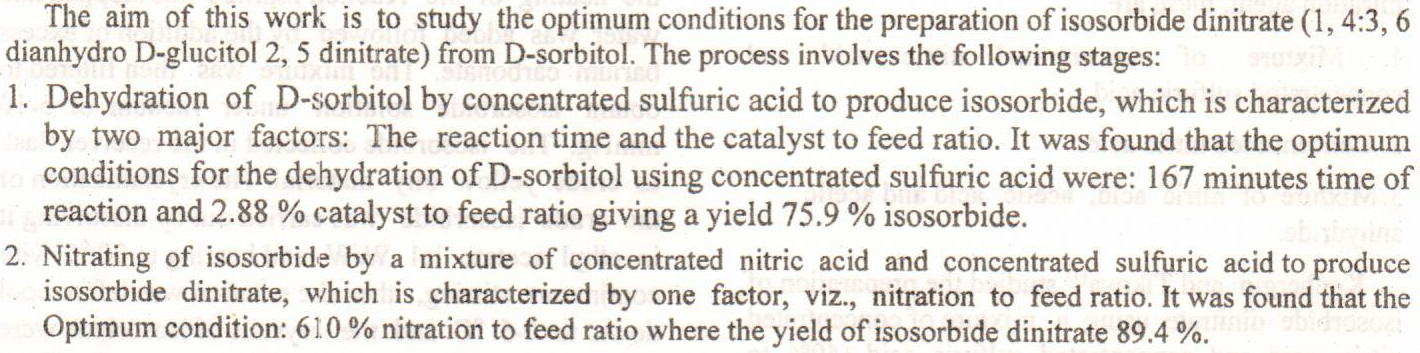
The Preparation of Isosorbide Dinitrate

The process for preparing activated carbon (AC) made from tea residue was described in this paper. Investigated were the physicochemical characteristics and adsorption efficiency of the produced AC. Activation with potassium hydroxide (KOH) and carbonization at 350 °C are the two key steps in the manufacturing of AC. The activated carbon was used to adsorb Tetracycline (TC). Different parameters were studied at room temperature to show their effects on the adsorption efficiency of TC. These parameters are the initial concentration of adsorbate TC, solution acidity pH, time of adsorption, and adsorbent dosage. The prepared active carbon was characterized using Fourier transform infrared spectroscopy (FTIR), scanning electron microsc
... Show More (5)
(5)
 (2)
(2)

 (10)
(7)
(10)
(7)
A new macrocyclic multidentate Schiff-base ligand Na4L consisting of two submacrocyclic units (10,21-bis-iminomethyl-3,6,14,17- tricyclo[17.3.1.18,12]tetracosa-1(23),2,6,8,10,12(24),13,17,19,21,-decaene-23,24-disodium) and its tetranuclear metal complexes with Mn(II), Co(II), Ni(II), Cu(II), and Zn(II) are reported. Na4L was prepared via a template approach, which is based on the condensation reaction of sodium 2,4,6-triformyl phenolate with ethylenediamine in mole ratios of 2 : 3. The tetranuclear macrocyclic-based complexes were prepared from the reaction of the corresponding metal chloride with the ligand. The mode of bonding and overall geometry of the compounds were determined through physicochemical and spectroscopic methods. These st
... Show More
(21)
In this work, an anti-reflection coating was prepared in the region (400-1000) nm of wavelength, with a double layer of silicon dioxide (SiO2) as an inner layer and the second layer of the mixture (SiO2) and titanium dioxide (TiO2) with certain ratios, as an outer layer using the chemical spraying method with a number of 6 sprays of layer SiO2 and 12 sprays of layer SiO2 - TiO2. Using the method of chemical spraying deposited on the glass as a substrate with a different number of sprays of SiO2, and a fixed number of TiO2-SiO2. The optical and structural properties were determined using UV-Vis spectroscopy and atomic force mi
... Show More
(7)
Flurbiprofen (FLB) is chemically 2-(3- fluoro-4-phenyl phenyl) propanoic acid. It is a nonsteroidal anti-inflammatory drug (NSAID) used in the treatment of rheumatoid arthritis and osteoarthritis. Oral administration of this drug is associated with severe gastrointestinal side effects like ulceration and gastrointestinal bleeding. The solution to this problem lies in the fact that topically applied NSAIDs are safer than orally. This study aims to prepare different topical semisolid formulation of FLB as cream base (o/w), (w/o) and gel base using different gel-forming agents in different concentrations. Comparing characterization properties in addition to release and diffusion study for all the prepared formulas to select the best on
... Show More
(7)
(3)
In this study, tin oxide (SnO2) and mixed with cadmium oxide (CdO) with concentration ratio of (5, 10, 15, 20)% films were deposited by spray pyrolysis technique onto glass substrates at 300ºC temperature. The structure of the SnO2:CdO mixed films have polycrystalline structure with (110) and (101) preferential orientations. Atomic force microscopy (AFM) show the films are displayed granular structure. It was found that the grain size increases with increasing of mixed concentration ratio. The transmittance in visible and NIR region was estimated for SnO2:CdO mixed films. Direct optical band gap was estimated for SnO2 and SnO2 mixed CdO and show a decrease in the energy gap with increasing mixing ratio. From Hall measurement, it was fou
... Show More
(1)
Schiff base of chitosan with Para-Dimethyl aminobenzaldehyde /PVA-Ag Nanocomposite have been prepared as antimicrobial polymer. The prepared chitosan Schiff base and chitosan Schiff base / PVA-Ag nanocomposite were characterized by FT-IR, SEM analysis and biological activity. The nanocomposite showed good activity against different types of bacteria.
This study aims to encapsulate atenolol within floating alginate-ethylcellulose beads as an oral controlled-release delivery system using aqueous colloidal polymer dispersion (ACPD) method.To optimize drug entrapment efficiency and dissolution behavior of the prepared beads, different parameters of drug: polymer ratio, polymer mixture ratio, and gelling agent concentration were involved.The prepared beads were investigated with respect to their buoyancy, encapsulation efficiency, and dissolution behavior in the media: 0.1 N HCl (pH 1.2), acetate buffer (pH 4.6) and phosphate buffer (pH 6.8). The release kinetics and mechanism of the drug from the prepared beads was investigated.All prepare
... Show More
(1)
An oxidative polymerization approach was used to create polyaniline (PANI) and Fe2O3 /PANI nanoparticle combination. Various characterization approaches were used to investigate the structural, morphological, and Fe2O3 /PANI nanoparticle structures. The findings support the synthesis of polycrystalline nanoparticle PANI and Fe2O3 /PANI spherical nanoparticle composites. Gram-positive bacteria are tested for antibacterial activity. Various quantities of Nanoparticles of PANI and Fe2O3 /PANI nanoparticle composites were used to test Staph-aureus and gram-negative bacteria, E-coli, and candida species. PANI has antibacterial properties against all microo
... Show More
(4)