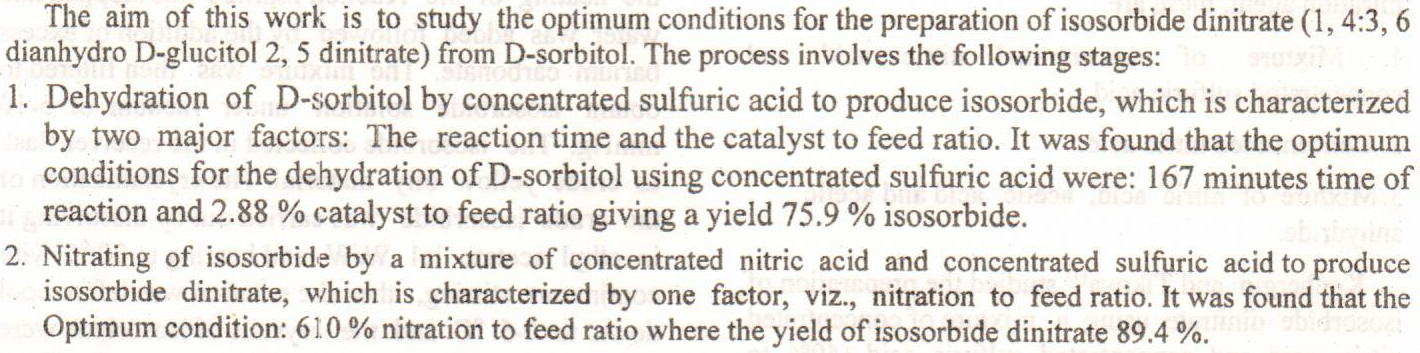
The Preparation of Isosorbide Dinitrate

By- products of corn starch industry were used to prepare media for propagation the lactic acid bacteria as a natural auxotroph. The by- products used were the corn steep water (S) and gluten extract (G) after a proper treatment to get them ready for media preparation. The results showed that it was possible to replace the peptone and meat extract by gluten extract in MRS medium. The growth was approximately similar to that obtained in standard MRS media. Corn steep water (S) was used as well and the growth enhanced by including Tween – 80 at 1% level. The later media named MZ, which was superior for growing standard and local strains and starters. The MZ medium modified by adding acetate and glacial acetic acid similarly to
... Show More
Background: Ceramic veneers represent the treatment of choice in minimally invasive esthetic dentistry; one of the critical factors in their long term success is marginal adaptation. The aim of the present study is to evaluate the marginal gap of ceramic veneers by using two different fabrication techniques and two different designs of preparation. Material and methods: A typodont maxillary central incisor used in the preparation from which metal dies were fabricated, which were in turn used to make forty stone dies. The dies divided into four experimental groups, each group had ten samples: A1: prepared with butt-joint incisal reduction and restored with IPS e.max CAD, A2: prepared with overlapped incisal reduction and restored with IPS e.
... Show MoreBackground: Fast dissolving oral drug delivery system is solid dosage form which disintegrates or dissolves within second when placed in the mouth without need of water or chewing. In present investigation, an attempt has been made to develop oral fast dissolving film of calcium channel blocker lacidipine. Method: Five formulas were prepared by solvent casting method using HPMC (METOLOSE)® as a film forming polymer and evaluated for their physical characteristics such as thickness, weight variation, folding endurance, drug content, disintegration time and in vitro drug release. The compatibility of the drug in the formulation was confirmed by FTIR and DSC studies. Result and Conclusion: The optimized formula F1 showed minimum in vitr
... Show More (2)
(2)

In this work preparation of antireflection coating with single layer of MgO using pulsed laser deposition (PLD) method which deposit on glass substrate with different thicknesses (90 and 100) nm annealed at temperature 500 K was done.
The optical and structural properties (X-ray diffraction) have been determined. The optical reflectance was computed with the aid of MATLAB over the visible and near infrared region. Results shows that the best result obtained for optical performance of AR'Cs at 700 shots with thickness 90 nm nanostructure single layer AR'Cs and low reflection at wavelength 550 nm.
 (2)
(2)
Phenytoin selective electrodes were constructed based on penytoin-phosphotungstate (Ph-PT) complex with different plasticizers; di-butyl phosphate (DBP), tri-butyl phosphate (TBP), di-butyl phthalate (DBPH),and o-nitro phenyl octyl ether (NPOE) phthalate. The electrodes based on DBPH, ONPOE plasticizers gave Narnistain slope which are, 56.4 and 55.3mV/decade with detection limit of 1.9x10⁻⁵ M , 1.8x10⁻⁵ and concentration range 10-1 to 10-4 M and pH range 3.0 – 8.0. The electrodes based on TBP and DBP showed non-Nernistain slopes, 40.2,40.5 mV/decade for both plasticizers. Interfering of some cations was investigated and shows no interfering with electrodes response. Potentiometric methods were used for measuring phenytion in
... Show More
ABSTRACT: In this research SnO2 thin films have been prepared by using hot plate atmospheric pressure chemical vapor deposition (HPCVD) on glass and Si (n-type) substrates at various temperatures. Optical properties have been measured by UV-VIS spectrophotometer, maximum transmittance about (94%) at 400 0C. Structure properties have been studied by using X-ray diffraction (XRD) , its shows that all films have a crystalline structure in nature and by increasing growth temperature from(350-500) 0C diffraction peaks becomes sharper and grain size has been change. Atomic force microscopy (AFM) uses to analyze the morphology of the Tine Oxides surface structure. Roughness & Root mean square for different temperature have been investigated. The r
... Show More
(1)
(1)
 (6)
(6)
Polymeric hollow fiber membrane is produced by a physical process called wet or dry/wet phase inversion; a technique includes many steps and depends on different factors (starting from selecting materials, end with post-treatment of hollow fiber membrane locally manufactured). This review highlights the most significant factors that affect and control the characterization and structure of ultrafiltration hollow fiber membranes used in different applications. Three different types of polymers (polysulfone PSF, polyethersulfone PES or polyvinyl chloride PVC) were considered to study morphology change and structure of hollow fiber membranes in this review. These hollow fiber membranes were manufactured with different proce
... Show More
ZnO nanostructures were synthesized in one step reaction at 80℃ without any extra treatments.(Zn (NO₃) ₂. 6H2O) and (NaOH) were used for synthesis. Production of ZnO nanostructures occurred relatively in short time. The obtained ZnO nanostructures were characterized by X-ray diffraction (XRD) and the atomic force microscope AFM. Carboxymethyleted PVA (CPVA) has been prepared and characterized.(CPVA) were composite with different ZnO nanoparticles concentrations. The composites are cast into films. The dielectric constant properties of the films were measured with hp LCR meter.