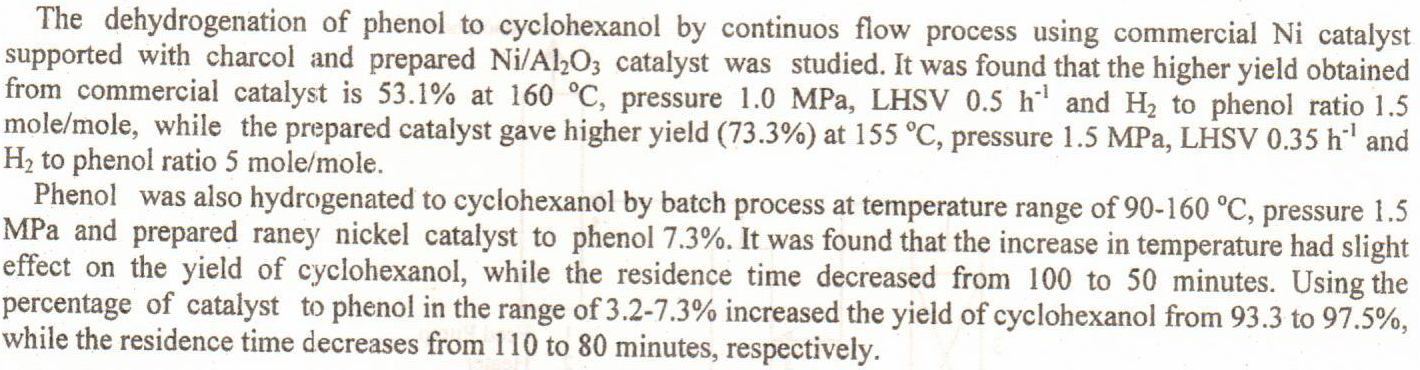
Batch and Continuous Process of Cyclohexanol Production

Sand production in unconsolidated reservoirs has become a cause of concern for production engineers. Issues with sand production include increased wellbore instability and surface subsidence, plugging of production liners, and potential damage to surface facilities. A field case in southeast Iraq was conducted to predict the critical drawdown pressures (CDDP) at which the well can produce without sanding. A stress and sanding onset models were developed for Zubair reservoir. The results show that sanding risk occurs when rock strength is less than 7,250 psi, and the ratio of shear modulus to the bulk compressibility is less than 0.8 1012 psi2. As the rock strength is increased, the sand free drawdown and depletion becomes larger. The CDDP
... Show More (11)
(11)

This paper presents a comparative study between different oil production enhancement scenarios in the Saadi tight oil reservoir located in the Halfaya Iraqi oil field. The reservoir exhibits poor petrophysical characteristics, including medium pore size, low permeability (reaching zero in some areas), and high porosity of up to 25%. Previous stimulation techniques such as acid fracturing and matrix acidizing have yielded low oil production in this reservoir. Therefore, the feasibility of hydraulic fracturing stimulation and/or horizontal well drilling scenarios was assessed to increase the production rate. While horizontal drilling and hydraulic fracturing can improve well performance, they come with high costs, often accounting for up t
... Show More
The emphasis of Master Production Scheduling (MPS) or tactic planning is on time and spatial disintegration of the cumulative planning targets and forecasts, along with the provision and forecast of the required resources. This procedure eventually becomes considerably difficult and slow as the number of resources, products and periods considered increases. A number of studies have been carried out to understand these impediments and formulate algorithms to optimise the production planning problem, or more specifically the master production scheduling (MPS) problem. These algorithms include an Evolutionary Algorithm called Genetic Algorithm, a Swarm Intelligence methodology called Gravitational Search Algorithm (GSA), Bat Algorithm (BAT), T
... Show More (16)
(13)
(16)
(13)

The Fauqi field is located about 50Km North-East Amara town in Missan providence in Iraq. Fauqi field has 1,640 MMbbl STOIIP, which lies partly in Iran. Oil is produced from both Mishrif and Asmari zones. Geologically, the Fauqi anticline straddles the Iraqi/Iranian border and is most probably segmented by several faults. There are several reasons leading to drilling horizontal wells rather than vertical wells. The most important parameter is increasing oil recovery, particularly from thin or tight reservoir permeability. The Fauqi oil field is regarded as a giant field with approximately more than 1 billion barrels of proven reserves, but it has recently experienced low production rate problems in many of its existing wells. This study
... Show More
Abstract
This research deals with Building A probabilistic Linear programming model representing, the operation of production in the Middle Refinery Company (Dura, Semawa, Najaif) Considering the demand of each product (Gasoline, Kerosene,Gas Oil, Fuel Oil ).are random variables ,follows certain probability distribution, which are testing by using Statistical programme (Easy fit), thes distribution are found to be Cauchy distribution ,Erlang distribution ,Pareto distribution ,Normal distribution ,and General Extreme value distribution . &
... Show More
A new method is characterized by simplicity, accuracy and speed for determination of Oxonuim ion in ionisable inorganic acid such as hydrochloric (0.1 - 10) ,Sulphuric ( 0.1 - 6 ),nitric ( 0.1 - 10 ), perchloric ( 0.1 - 7 ), acetic (0.1 - 100 ) and phosphoric ( 0.1 - 30 ) ( mMol.L-1 )acids. By continuous flow injection analysis. The proposed method was based on generation of bromine from the Bro-3-Br-- H3O+. Bromine reacts with fluorescein to quenches the fluorescence . A sample volume no.1 (31μl) and no.2 (35μl) were used with flow rate of 0.95 mL.min-1 using H2O line no.1as carrier stream and 1.3 mL.min-1 using fluorescein sodium salt line no.2. Linear regression of the concentration ( mMol.L-1 ) Vs quenched fluorescence gives a correla
... Show More
(2)
This presented study is to make comparison of cross sections to produce 71As, 72As, 73As and 74As via different reactions with particle incident energy up to 60 MeV of alpha 100 MeV of proton as a part of systematic studies on particle-induced activations on enriched Ge, Ga, Rb and Nb targets and neutron capture. Theoretical calculation of production yield, and suggestion of optimum reaction to produce 71As, 72As, 73As and 74As, based on the main published and approved experimental results of excitation functions were calculated.
(30)
(28)

An investigation was conducted for the determination of the effects of the forming conditions in the production of Gamma Alumina catalyst support on the crushing strength property. Eight variables were studied , they are ;binder content which is the sodium silicate , Solvent content which is the water, speed of mixing , time of mixing, drying temperature , drying time , calcinations temperature and the calcinations time
Design of the experiments was made by using the response Surface method in Minitab 15 software which supply us 90 experiments .
The results of this investigation show that the crushing strength for the dried Gamma alumina extrudate was affected by the drying temperature and the drying time only and there is no inter