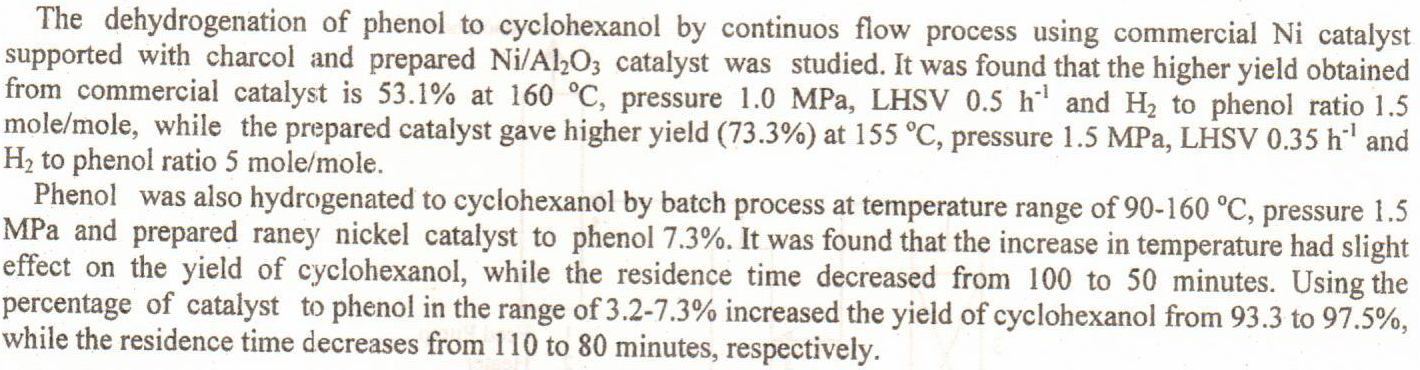
Batch and Continuous Process of Cyclohexanol Production

Quality control charts are limited to controlling one characteristic of a production process, and it needs a large amount of data to determine control limits to control the process. Another limitation of the traditional control chart is that it doesn’t deal with the vague data environment. The fuzzy control charts work with the uncertainty that exists in the data. Also, the fuzzy control charts investigate the random variations found between the samples. In modern industries, productivity is often of different designs and a small volume that depends on the market need for demand (short-run production) implemented in the same type of machines to the production units. In such cases, it is difficult to determine the contr
... Show More (1)
(1)

 (11)
(5)
(11)
(5)

 (3)
(1)
(3)
(1)
Several toxigenic cyanobacteria produce the cyanotoxin (microcystin). Being a health and environmental hazard, screening of water sources for the presence of microcystin is increasingly becoming a recommended environmental procedure in many countries of the world. This study was conducted to assess the ability of freshwater cyanobacterial species Westiellopsis prolifica to produce microcystins in Iraqi freshwaters via using molecular and immunological tools. The toxigenicity of W. prolifica was compared via laboratory experiments with other dominant bloom-forming cyanobacteria isolated from the Tigris River: Microcystis aeruginosa, Chroococcus turigidus, Nostoc carneum, and Lyngbya sp. signifi
... Show More
(6)
The objective of this study is to enable the role of modern and advanced computerized information systems. The model or mechanism should be developed by collecting the necessary information about the taxpayers and the sources of the taxpayers' income, on the basis of which the accuracy of the inventory process will be adopted. In addition to studies related to computerized information systems and showing their importance to the tax institution. To achieve the objectives of the study and to answer its questions, the researcher relied on collecting data and information on the subject on the literature and previous studies The secondary sources, which also formed the theoretical framework of the study, were obtained either as a practical fr
... Show More
Copper electrodeposition by electrorefining process in acidic sulfate media contains 40 g/l of cupric ions and 160 g/l of sulfuric acid was achieved to study the influence of the operating parameters on cathode purity, surface morphology, deposition rate, current efficiency and power consumption. These operating parameters and there ranges are: current density 200, 300 and 400 A/m2, electrolyte temperature 35, 50 and 65 oC, electrodes spacing 15, 30 and 45 mm and electrolyte residence time 6, 4 and 2 h were utilized. XRF, SEM and EDX analyses were attained to clarify the properties of the produced cathode.
The Dirichlet process is an important fundamental object in nonparametric Bayesian modelling, applied to a wide range of problems in machine learning, statistics, and bioinformatics, among other fields. This flexible stochastic process models rich data structures with unknown or evolving number of clusters. It is a valuable tool for encoding the true complexity of real-world data in computer models. Our results show that the Dirichlet process improves, both in distribution density and in signal-to-noise ratio, with larger sample size; achieves slow decay rate to its base distribution; has improved convergence and stability; and thrives with a Gaussian base distribution, which is much better than the Gamma distribution. The performance depen
... Show More
(5)
The aim of this study is to compare and contrast the science process skills (SPS) included in the 10th-12th grade physics textbooks content utilized in Yemeni schools. The study revealed weaknesses and strengths in the textbooks’ content. For instance, a number of science process skills (SPS), such as measuring, predicting and hypothesizing, have been neglected in the 11th grade textbook. For all three textbooks content, the maximum percentage of basic science process skills (BSPS) was devoted to observation. However, the maximum percentage of integrated science process skills (ISPS) was different for each grade: experimenting had the highest percentage for 10th grade, interpreting data for 11th grade, and operational definitions for 12th
... Show More