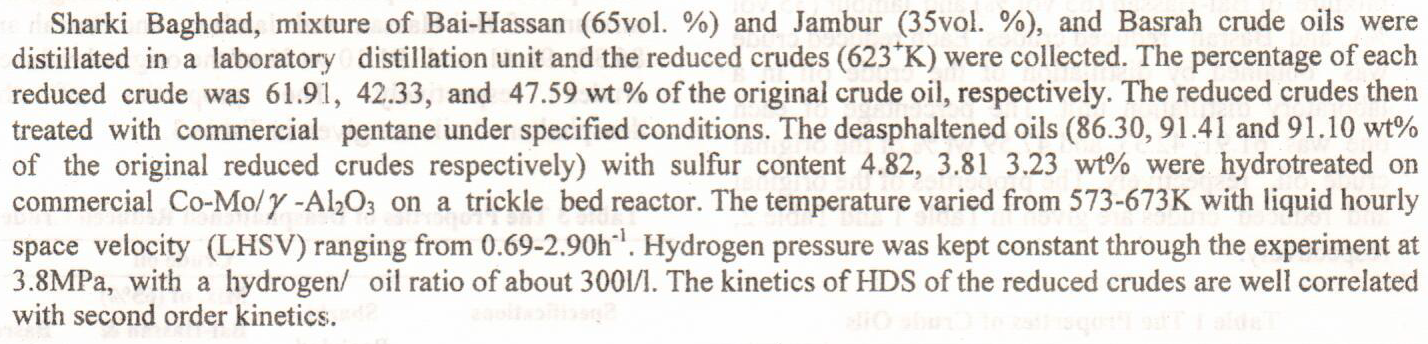
Production of Low Sulfur Fuel Oil from Different Iraqi Residues Crudes

 (41)
(41)
 (37)
(37)



Products’ quality inspection is an important stage in every production route, in which the quality of the produced goods is estimated and compared with the desired specifications. With traditional inspection, the process rely on manual methods that generates various costs and large time consumption. On the contrary, today’s inspection systems that use modern techniques like computer vision, are more accurate and efficient. However, the amount of work needed to build a computer vision system based on classic techniques is relatively large, due to the issue of manually selecting and extracting features from digital images, which also produces labor costs for the system engineers. In this research, we pr
... Show More
(2)
Background: The accuracy of fitness of any dental casting is imperative for the success of any prosthodontic treatment. From the time that dental casting was first introduced, efforts have been made to produce more accurate and better fitted castings with minimal marginal discrepancy. The aim of this in vitro study was to evaluate the effects of three different investing and burnout techniques on the vertical marginal discrepancies ofceramometalcopings invested with two types of phosphate- bonded investments. Materials and methods: Sixty wax patterns were fabricated on a standardized prepared brass die representing an upper central incisor by the aid of a custom-made split mold. Three different investing and burnout techniques were applied
... Show More
(4)
Abstract Ternary Silver Indium selenide Sulfur AgInSe1.8S0.2 in pure form and with a 0.2 ratio of Sulfur were fabricated via thermal evaporation under vacuum 3*10-6 torr on glasses substrates with a thickness of (550) nm. These films were investigated to understand their structural, optical, and Hall Characteristics. X-ray diffraction analysis was employed to examine the impact of varying Sulfur ratios on the structural properties. The results revealed that the AgInSe1.8S0.2 thin films in their pure form and with a 0.2 Sulfur ratio, both at room temperature and after annealing at 500 K, exhibited a polycrystalline nature with a tetragonal structure and a predominant orientation along the (112) plane, indicating an enhanced de
... Show More
Estimation of mechanical and physical rock properties is an essential issue in applications related to reservoir geomechanics. Carbonate rocks have complex depositional environments and digenetic processes which alter the rock mechanical properties to varying degrees even at a small distance. This study has been conducted on seventeen core plug samples that have been taken from different formations of carbonate reservoirs in the Fauqi oil field (Jeribe, Khasib, and Mishrif formations). While the rock mechanical and petrophysical properties have been measured in the laboratory including the unconfined compressive strength, Young's modulus, bulk density, porosity, compressional and shear -waves, well logs have been used to do a compar
... Show More
(5)
The Compressional-wave (Vp) data are useful for reservoir exploration, drilling operations, stimulation, hydraulic fracturing employment, and development plans for a specific reservoir. Due to the different nature and behavior of the influencing parameters, more complex nonlinearity exists for Vp modeling purposes. In this study, a statistical relationship between compressional wave velocity and petrophysical parameters was developed from wireline log data for Jeribe formation in Fauqi oil field south Est Iraq, which is studied using single and multiple linear regressions. The model concentrated on predicting compressional wave velocity from petrophysical parameters and any pair of shear waves velocity, porosity, density, and
... Show More
(2)
The Compressional-wave (Vp) data are useful for reservoir exploration, drilling operations, stimulation, hydraulic fracturing employment, and development plans for a specific reservoir. Due to the different nature and behavior of the influencing parameters, more complex nonlinearity exists for Vp modeling purposes. In this study, a statistical relationship between compressional wave velocity and petrophysical parameters was developed from wireline log data for Jeribe formation in Fauqi oil field south Est Iraq, which is studied using single and multiple linear regressions. The model concentrated on predicting compressional wave velocity from petrophysical parameters and any pair of shear waves velocity, porosity, density, a
... Show More
(2)
In current study a computation fluid dynamic (CFD) technique was used to investigate the effect of groynes shape and spacing on the scour pattern and the maximum scour depth in open channel flow. CFD model have been validated throughout comparing the numerical results with three previous experimental studies for a single groyne located in open channel with three different shapes (L, quadrant, and parabola shapes). The comparison revealed very good agreement between numerical results of the maximum scour depth with the results of all experimental models. Moreover, investigations of the effect of multi-groynes (three groynes and four groynes) arranged in parallel with constant spacing and also with variable spacing have been done, the
... Show More
(2)
A geological model was built for the Sadi reservoir, located at the Halfaya oil field. It is regarded as one of the most significant oilfields in Iraq. The study includes several steps, the most essential of which was importing well logs from six oil wells to the Interactive Petrophysics software for conducting interpretation and analysis to calculate the petrophysical properties such as permeability, porosity, shale volume, water saturation, and NTG and then importing maps and the well tops to the Petrel software to build the 3D-Geological model and to calculate the value of the original oil in place. Three geological surfaces were produced for all Sadi units based on well-top data and the top Sadi structural map. The reservoir has
... Show More
(8)
(2)