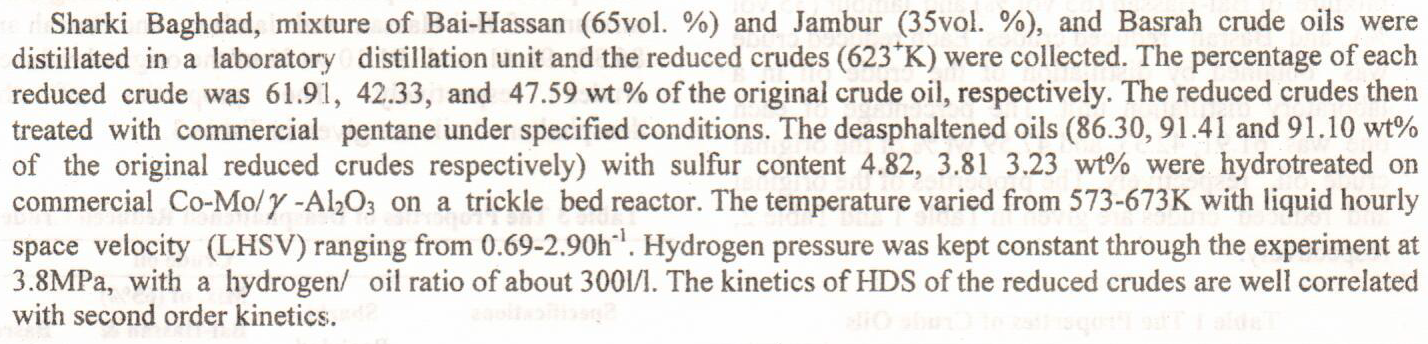
Production of Low Sulfur Fuel Oil from Different Iraqi Residues Crudes

The present work aimed to investigate the neuraminidase (nan1) gene expression in 32 different clinical isolates of Pseudomonas aeruginosa to explore the role of the enzyme in different types of infection and might give a better understanding of host cell-pathogens interaction. In addition, the effect of monosaccharide D-mannose on neuraminidase gene expression in eight isolates was studied by utilizing a reverse transcription-quantitative polymerase chain reaction (RT-qPCR). The results demonstrated that the highest expression of nan1 gene was in otitis samples (208,913.81) which were significantly higher than that from other infections (P < 0.01). While, the concentrations of gene copies obtained from urin
... Show More (22)
(22)
 (3)
(3)



One hundred isolates of Pseudomonas aeruginosa were obtained from patients admitted to Baghdad hospitals, Iraq during the period between May 2018 until July 2018. These isolates were distributed as 15 isolates from blood, 25 isolates from urinary tract infections, 10 isolates from sputum, 12 isolates from wounds, 15 isolates from ear infections, 15 isolates from bronchial wash of patients suffering from respiratory tract infections in addition to 8 isolates from cystic fibrosis patients. The isolates were initially identified by culturing on MacConkey agar, blood agar and P. aeruginosa agar then diagnosed by performing some morphological and biochemical tests. The second diagnosis was done by API 20E system followed by Vitek 2 compact syste
... Show More
(14)
(10)
Background: Globally, breast cancer is the second leading cause of death among women in Iraq. Several genetic and environmental factors are associated..
Pharmaceuticals are widely distributed in different applications and also released into the environment. Adsorption of Ciprofloxacin HCl (CIPH) on Porcelinaite was studied at ambient conditions. The adsorption isotherms can be well described using the Freundlich and Temkin equations. The pH of the solution influences significantly the adsorption capacity of Porcelinaite, the adsorption of CIPH increased from the initial pH 1.3 and then decreased over the pH rang of 3.8-9. The adsorption is sensitive to the change in ionic Strength, which indicate that electrostatic attraction is a significant mechanism for sorption process. The enthalpy change (ΔH) for the adsorption of CIPH onto Porcelinaite signifies an endothermic adsorption. The ΔG va
... Show MoreOne of the most opportunistic mycosis globally is the Candida ssp., which is considered as the most agent that cause nosocomial urinary tract infections (UTIs), oral candidiasis and genitourinary candidiasis. This study included 100 samples of Iraqi subjects suffering from urinary tract infections. Identification of Candida have been done by different methods such as; characteristic of colony on culture, gram stain, and microscopically. This study aimed to isolation and identification of Candida spp from urine sample of UTI patients and find the relevance of ages and blood group of patients with the infections rate, also determine the effect of age on ESR and CRP levels in the patients. The results showed the higher frequency of
... Show More
(1)
Pharmaceuticals are widely distributed in different applications and also released into the environment. Adsorption of Ciprofloxacin HCl (CIPH) on Porcelinaite was studied at ambient conditions. The adsorption isotherms can be well described using the Freundlich and Temkin equations. The pH of the solution influences significantly the adsorption capacity of Porcelinaite, the adsorption of CIPH increased from the initial pH 1.3 and then decreased over the pH rang of 3.8-9. The adsorption is sensitive to the change in ionic Strength, which indicate that electrostatic attraction is a significant mechanism for sorption process. The enthalpy change (∆H) for the adsorption of CIPH onto Porcelinaite signifies an endothermic adsorption. The ∆G
... Show MoreThis study focused on treating wastewater to remove phosphorus by adsorption onto naturaland local materials. Burned kaolin, porcelinite, bauxite and limestone were selected to be testedas adsorption materials.The adsorption isotherms were evaluated by batch experiments, studyingthe effects of pH, temperature and initial phosphorus concentration. The results showed that at pH6, temperature 20°C and 300 mg/l initial phosphorus concentration; the sorption capacity was0.61, 9, 10 and 13 mg/g at 10 h contact time, for burned kaolin, porcelanite, limestone and bauxiterespectively. As the pH increased from 2 to 10 the removal efficiency for the materials differs inbehaviour. The removal efficiency increased from 40 to 90 % for limestone, and dec
... Show More
(3)
The removal of boron from aqueous solution was carried out by electrocoagulation (EC) using magnesium electrodes as anode and stainless steel electrodes as cathode. Several operating parameters on the removal efficiency of boron were investigated, such as initial pH, current density, initial boron ion concentration, NaCl concentration, spacing between electrodes, electrode material, and presence of carbonate concentration. The optimum removal efficiency of 91. 5 % was achieved at a current density of 3 mA/cm² and pH = 7 using (Mg/St. St. ) electrodes, within 45 min of operating time. The concentration of NaCl was o. 1 g/l with a 0.5cm spacing between the electrodes. First and second order rate equation were applied to study adsorp
... Show More
(1)
Based on collections made during March to September 2012. A totals of 58 species belong to 33 genera were identified from extra north to extra south of Erbil governorate, among them 30 species are registered as a new record to flora of Iraq. Most attention was paid to the most common and abundant lichens that present almost in most locations, which were Collema cristatum, Diploschistes scruposus, Lecanora dispersa, Lecanora murales, Pertusaria flavicunda, Placidium lacinulatum, Thelomma californicum and Verrucaria Maura.