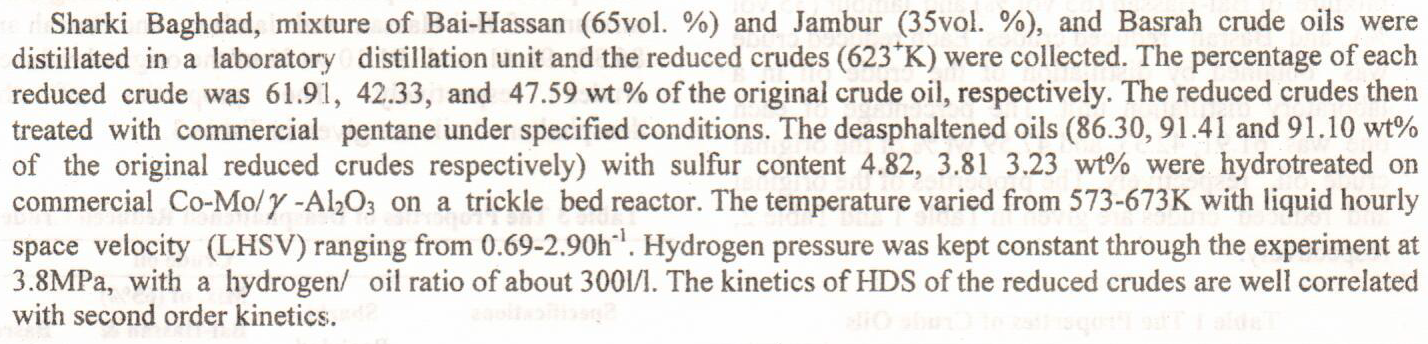
Production of Low Sulfur Fuel Oil from Different Iraqi Residues Crudes

This paper includes an experimental study of hydrogen mass flow rate and inlet hydrogen pressure effect on the fuel cell performance. Depending on the experimental results, a model of fuel cell based on artificial neural networks is proposed. A back propagation learning rule with the log-sigmoid activation function is adopted to construct neural networks model. Experimental data resulting from 36 fuel cell tests are used as a learning data. The hydrogen mass flow rate, applied load and inlet hydrogen pressure are inputs to fuel cell model, while the current and voltage are outputs. Proposed model could successfully predict the fuel cell performance in good agreement with actual data. This work is extended to developed fuel cell feedback
... Show More (5)
(5)
 (1)
(1)


The adult worms of the Microphallidae family are mainly found as intestinal parasites of birds and mammals, while metacercariae is most commonly found in decapodal crustaceans. The Microphallidaeare family is spread throughout the world. It includes approximately 47 genera. Mature worms usually enter the digestive system of vertebrates, especially birds and mammals. Microphallidae contain eight subfamilies: Androcotylinae - Basantisiinae - Endocotylinae - Gynaecotylinae - Levinseniellinae - MaritrematinaeMicrophallinae - Sphairiotrematinae. Therefore, due to the lack of studies on the Microphallidae family in Iraq, we began to develop a database on this important family.
Many oil and gas processes, including oil recovery, oil transportation, and petroleum processing, are negatively impacted by the precipitation and deposition of asphaltene. Screening methods for determining the stability of asphaltenes in crude oil have been developed due to the high cost of remediating asphaltene deposition in crude oil production and processing. The colloidal instability index, the Asphaltene-resin ratio, the De Boer plot, and the modified colloidal instability index were used to predict the stability of asphaltene in crude oil in this study. The screening approaches were investigated in detail, as done for the experimental results obtained from them. The factors regulating the asphaltene precipitation are different fr
... Show More
(10)
In the present work, asphaltenes and resins separated from emulsion samples collected from two Iraqi oil wells, Nafut Kana (Nk) and Basrah were used to study the emulsion stability. The effect of oil resins to asphaltene (R/A) ratio, pH of the aqueous phase, addition of paraffinic solvent (n-heptane), aromatic solvent (toluene), and blend of both (heptol) in various proportions on the stability of emulsions had been investigated. The conditions of experiments were specified as an agitation speed of 1000 rpm for 30 minutes, heating at 50 °C, and water content of 30%. The results showed that as the R/A ratio increases, the emulsion will be unstable and the amount of water separated from emulsion increases. It was noticed that the em
... Show MoreThis study focuses on the use of an optimum amount of Sodium Polyacrylate (SP) for designing cement slurry with the high performance of rheological properties and displacement efficiency. A laboratory study has been carried out on the cement slurry which prepared with SP as superabsorbent polymer. SP has been providing an internal water source that helps in the hydration process, and curing and ultimately increases the cement strength. Also improves the cement performance by improving the cement stability. Several batches were prepared to determine the proper amount of SP to add it in the cement slurry. Also, we studied its effect on cement density, amount of free water in order to observe the rheological properties, and thickening time.
... Show MoreThe optimum conditions for the production of neutral protease from local strain Aspergillus niger var carbonarius by solid – state fermentation system (Wheat bran) moisted with 0.2 M phosphate buffer (PH7.0) . the hydration ratio was 1:5 (V:W) . the concentration of inoculum was 1×10⁶ spores per 10 gram of solid materials , initial P H 6.5 and 96 hours of incubation period at 30? C .the enzyme activity was 1300 unit / ml and specific activity was 1550 unit / mg protein .
(2)
(6)
(3)
