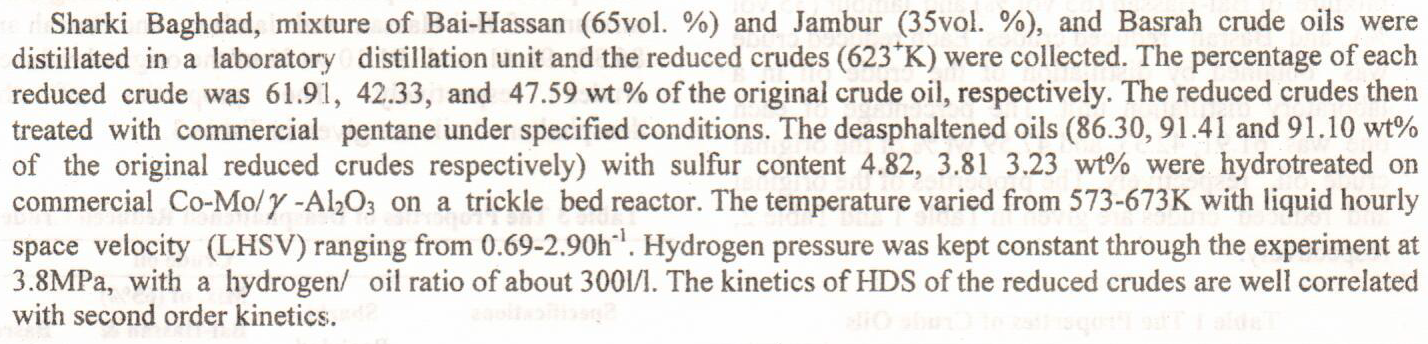
Production of Low Sulfur Fuel Oil from Different Iraqi Residues Crudes

Azo derivative ligand[H3L] have been synthesized by the reaction of diazonium salt of p-amino benzoic acid with orcinol in(1:1)mole ratio. The bidente ligand was reacted with the metal ions MnII,FeIIandCrIIIin(2:1)mole ratio via reflux in ethanol using Et3N as a base to give complexes of the general formula: [ M(H2L)2(H2O)x]Cly The synthesized compounds were characterized by spectroscopic methods[ I.R , UV-Vis, A.A and H1 NMR]along with melting point, chloride content and conductivity measurements. The complexes were screend for their in vitro antibacterial activity against one strain of staphylococcus as Gram(+) positive and one strain of pseudomonas as Gram(-) Negative, using the agar diffusion technique.
Background: In capturing a negative image, the digital impression secures a digital record for the purposeof designing and creating restorations. The introduction of scanning system presents a paradigm shift in the way of the dental impression procedure and encourages the accuracy of obtained restoration especially in the marginal area as a result of producing accurate final impression The digital system offers many advantages over the Conventional method.. The objective of this present in vitro study was to evaluate the marginal fitness of all ceramic crowns fabricated by direct digital scanning of the prepared tooth using two types of intra-oral cameras (Bluecam camera with strip light projection technique and Omnicam camera with video sa
... Show More (3)
(3)

This research includes the synthesis of some new N-Aroyl-N \ -Aryl thiourea derivatives namely: N-benzoyl-N \ -(p-aminophenyl) thiourea (STU1), N-benzoyl-N \ -(thiazole) thiourea (STU2), N-acetyl-N ` -(dibenzyl) thiourea (STU3). The series substituted thiourea derivatives were prepared from reaction of acids with thionyl chloride then treating the resulted with potassium thiocyanate to affored the corresponding N-Aroyl isothiocyanates which direct reaction with primary and secondary aryl amines, The purity of the synthesized compounds were checked by measuring the melting point and Thin Layer Chromatography (TLC) and their structure, were identified by spectral methods [FTIR,1H-NMR and 13C-NMR].These compounds were investigated as a
... Show MoreThe study aims to use the European Excellence Model (EFQM) in assessing the institutional performance of the National Center for Administrative Development and Information Technology in order to determine the gap between the actual reality of the performance of the Center and the standards adopted in the model, in order to know the extent to which the Center seeks to achieve excellence in performance to improve the level of services provided and the adoption of methods Modern and contemporary management in the evaluation of its institutional performance.
The problem of the study was the absence of an institutional performance evaluation system at the centre whereby weaknesses (areas of improvement) and st
... Show More
Spin coating technique has been applied in this work to prepared Xerogel films doped with Rhodamine 6G laser dyes. The solid host of laser dye modifies its spectroscopic properties with respect to liquid host. During the spin coating process the dye molecules suffer from changing their environment. The effects of three parameters were studied here: the spinning speed, multilayer coating and formaldehyde addition
The current study was carried out at the Fields belongs of Horticulture Department, Collage of Agricultural Engineering Science, University of Baghdad, Al-Jadiriyah for the spring season 2016 -2017 to study the effect for inoculation mycorrhizae and folair application with bio stimulators and their interaction in the growth characters of (local okra ptera). A factorial experiment (2 in randomized complete block design (RCBD), the experiment included (12) treatment Distributed in three replicates. The three factors used in this experiment included . The inoculation with control (C) Mycorrhizae ( M ) , Biozyme (B ) ( B1 2cm3.L-1), ( B2 4cm1-.L-1) , Phosphalas (P) (P 2cm3.L-1), ( M + B1), ( M + B2), (P +
... Show More
CD40 is a type 1 transmembrane protein composed of 277 amino acids, and it belongs to the tumor necrosis factor receptor (TNFR) superfamily. It is expressed in a variety of cell types, including normal B cells, macrophages, dendritic cells, and endothelial cells, as a costimulatory molecule. This study aims to summarize the CD40 polymorphism effect and its susceptibility to immune-related disorders. The CD40 gene polymorphisms showed a significant association with different immune-related disorders and act as a risk factor for increased susceptibility to these diseases.