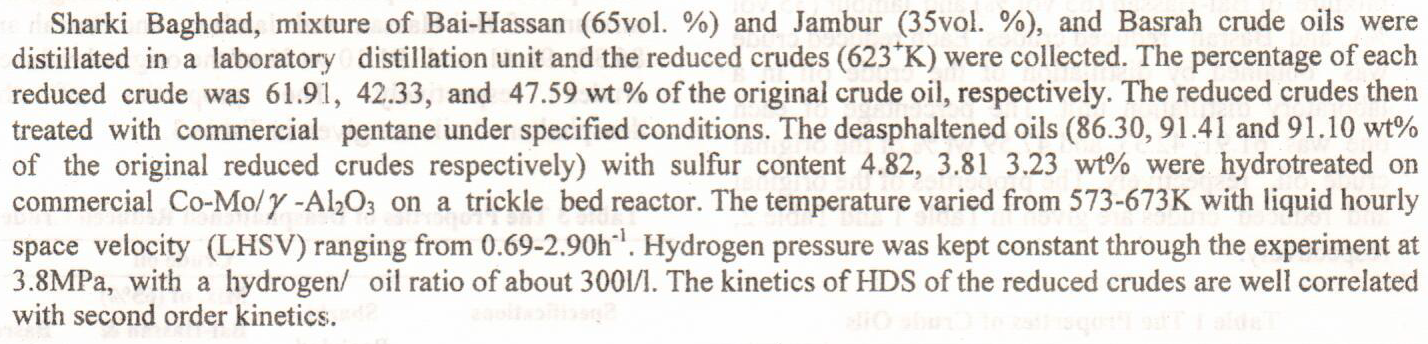
Production of Low Sulfur Fuel Oil from Different Iraqi Residues Crudes

In this part of programme , different bacterial isolates mainly Salmonella spp, Shigella spp and Escherichia coli were used for antagonism with Saccharomyces boulardii under different conditions . S.boulardii was grown under aerobic conditions and antagonized with young overnight nutrient broth cultures of test bacterial isolates and other kept in refrigerator for a week after full growth . Young cultures were more susceptible to antagonistic effect of yeast compared to old cultures and on isolates grown on solid medium for 24 hr. S.boulardii grown under aerobic and microaerobic conditions and antagonized with overnight broth cultures of test bacterial isolates , The results revealed that aerobic cultures of yeast had more inhibito
... Show More
Background: With the increased in the demands of adult orthodontics, the challenge of direct bonding to non-enamel surface (zirconium) had been increased. The present study was carried out to compare the shear bond strength of three different brackets (stainless steel, sapphire and composite) bonded to zirconium surface and study the mode of bond failure. Materials and methods: The sample was comprised of 30 models (8mm *6mm*1.5mm) of full contour zirconium veneers. They were divided into three groups according to the brackets type; all samples were treated first by sandblast with aluminum oxide particle 50 µm then coated by z-prime plus primer. A central incisor bracket of each group was bonded to the prepared zirconium surface with lig
... Show More (2)
(2)
 (4)
(4)

In the present work, different thicknesses of CdS film were prepared by chemical bath deposition. Z-Scan technique was used to study the nonlinear refractive index and nonlinear absorption coefficients. Linear optical testing were done such as transmission test, and thickness of films were done by the interference fringes (Michelson interferometer). Z-scan experiment was performed at 650nm using CW diode laser and at 532nm wavelength. The results show the effect of self-focusing and defocusing that corresponds with nonlinear refraction n2. The effect of two-photon absorption was also studied, which correspond to the nonlinear absorption coefficient B.
The amount of protein in the serum depends on the balance between the rate of its synthesis, and that of its catabolism or loss. Abnormal metabolism may result from nutritional deficiency, enzyme deficiency, abnormal secretion of hormones, or the actions of drugs and toxins. Renal cancer is the third most common malignancy of the genitourinary system, and accounts for 3% of adult malignancies globally. Total serum proteins were measured in malignant kidney tumor, benign kidney tumors, and non tumoral kidney diseases patient groups, as well as in healthy individuals. A significant decrease (p< 0.001) of total serum protein levels in patients with malignant kidney tumors when compared with those of benign tumors, non tumoral diseases, and hea
... Show More
In this study, geopolymer mortar was designed in various experimental combinations employing 1% micro steel fibers and was subjected to different temperatures, according to the prior works of other researchers. The geopolymer mortar was developed using a variety of sustainable material proportions (fly ash and slag) to examine the influence of fibers on its strength. The fly ash weight percentage was 50%, 60%, and 70% by slag weight to study its effect on the geopolymer mortar's properties. The optimal ratio produced the most significant results when mixed at a 50:50 ratio of fly ash and slag with 1% micro steel fibers at curing temperature 240oC for 4 hours through two days. The compressive strength of the geopolymer mortar increas
... Show More
(12)
Background: Complete removal of filling material from the root canal is an essential requirement for endodontic retreatment. The purpose of the present study is to evaluate and compare the dissolving capabilities of various solvents (Xylene, Eugenate Desobturator, Eucalyptol, EDTA and Distilled water (as a control)) on four different types of sealer (Endofill, Apexit Plus, AH Plus and EndoSequence bioceramic sealer). Materials and method: Eighty samples of each sealer were prepared according to the manufacturers' instructions and then divided into ten groups (of 8 samples) for immersion in the respective solvents for 2 and 5 min immersion periods. Each sealer specimen was weighed to obtain its initial mass. The specimens were immersed in
... Show More
(1)
Background: to evaluate the effect of different dentifrices on the surface roughness of two composite resins (nanofilled-based and nanoceramic – based composite resins). Materials and methods: Forty specimens (diameter 12 mm and height of 2mm) prepared from different composite resin materials: Z350 (nanofilled composite, and Ceram-X (nanoceramic) .they were subjected to brushing simulation equivalent to the period of 1 year. The groups assessed were a control group brushed with distilled water (G1), Opalescence whitening toothpasteR (G2), Colgate sensitive pro-relief (G3) and Biomed Charcoal Toothpaste (G4). The initial and final roughness of each group was tested by surface roughness tester. The results were statistically analyzed using
... Show More
(1)
Abstract: An unfavorable complication of root canal is vertical root fracture. The aim of present study is to evaluate the vertical root fracture of treated teeth filled with gutta percha and Resilon obturating material using different sealers. Forty mandibular premolars used in the study. Canals randomly divided into four groups (n=10). Group-A eugenol-based (Endofill) sealer with gutta percha; GroupB epoxy-amine (AH Plus) sealer with gutta percha; Group-C resin-based (Real Seal) sealer with Resilon; or Group-D epoxide-based (Perma Evolution) sealer with gutta percha. Roots mounted vertically in cold cure acrylic blocks and subjected to vertical loading with a crosshead speed of 1mm ̸min. The point at which fracture of the roots occurred
... Show More