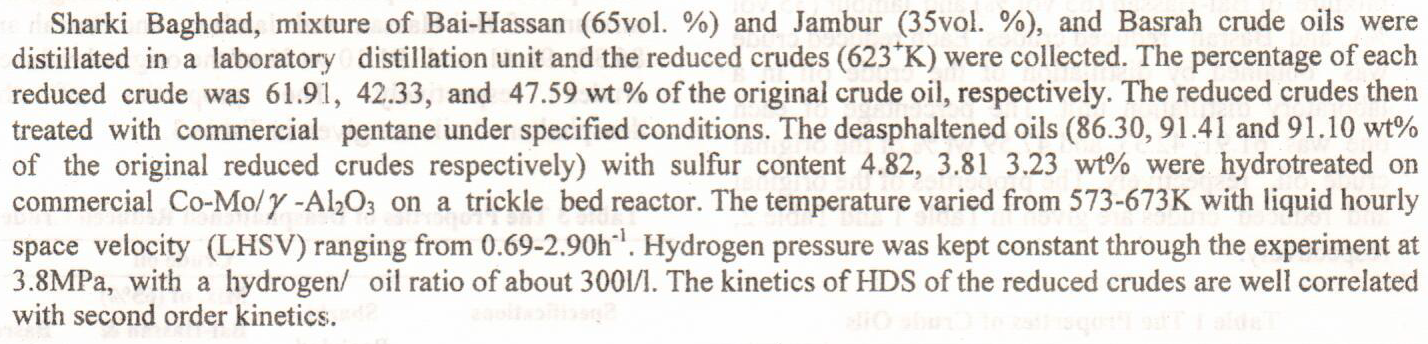
Production of Low Sulfur Fuel Oil from Different Iraqi Residues Crudes

The present study aimed to investigate the histology of the testis in golden hamster during 1, 28 and 60 day of old. Tissue samples were processed, sectioned and subjected to specific stains to reveal histological details. Observation of one day old showed the testicle enclosed by undifferentiated thin layer of testicle capsule which consisted of undifferentiated myoblasts and fibroblasts small size seminiferous tubules appeared, one layer of spermatogonium cells (Type-A) which revealed mitotic figures, at 28 day old the capsule was consisted of thick outer fibromuscular layer and thick inner vascular layer that revealed encouraged blood vessels and cells, Spermatogonial cells type-A & B appeared as large
... Show More
Background: The microhardness of a composite resin is a vital parameter that is used to determine its clinical behavior. Measuring the microhardness of a composite resin has been used as an indirect method to assess its degree of conversion and extent of polymerization. The purpose of this in vitro study was to evaluate the effect of three curing distances (0, 2, and 4 mm) on the microhardness of the top and bottom surfaces of three types of flowable bulk-fill composite resins (smart dentin replacement, Opus bulk fill flow, and Tetric N). Material and method: Sixty-three specimens from the three types of composite resins (n=21) were fabricated using Teflon mold with a 4mm depth and a 5 mm internal diameter and cured for 20 seconds. For e
... Show More (3)
(3)
 (1)
(1)

This paper reports a comprehensive study on the behavior of concavely curved soffit reinforced concrete (RC) beams strengthened in flexure with carbon fiber-reinforced polymer (CFRP) composites under static loading. The main objective of this paper is to explore the effect of surface concavity on the bond performance of externally bonded wet layup CFRP sheets and laminates. An experimental program consisting of flexural strengthening of 24 RC beams with concavely curved soffits was carried out. All specimens were simply supported RC beams tested under three-point bending. Of the 24 beams, 6 beams were flat soffit RC beams, and the remainder were fabricated with concavely curved soffits with a degree of curvature that is ranging from 5 mm/m
... Show More
(14)
(10)
(8)

Background: The finite element method (FEM) is expected to be one of the most effective computational tools for measuring the stress on implant-supported restorations. This study was designed using the 3D-FEM to evaluate the effect of two adhesive luting types of cement on the occlusal stress and deformation of a hybrid crown cemented to a mono-implant. Materials and Method: The mono-screw STL file was imported into the CAD/CAM system library from a database supported by De-Tech Implant Technology. This was to assist in the accurate reproduction of details and design of a simulated implant abutment. Virtually, a digital crown was designed to be cemented on an abutment screw. A minimum occlusal thickness of 1mm and marginal fitting of 1.2
... Show More
(2)
(2)
In their growth stages, cities become an aggregation of different urban contexts as a result of development or investment projects with other goals, which creates urban tension at several levels. Previous studies presented different approaches and methods to address specific aspects of urban stress, and thus contemporary visions and propositions varied, which required a field for research. The research, from a review of the proposals, the research problem emerged in need to study the indicators and trends of balanced urban development that address the tensions between different social, economic and urban contexts". Accordingly, the objective of the research is determined as "Building a comprehe
... Show MoreIn this paper, image compression technique is presented based on the Zonal transform method. The DCT, Walsh, and Hadamard transform techniques are also implements. These different transforms are applied on SAR images using Different block size. The effects of implementing these different transforms are investigated. The main shortcoming associated with this radar imagery system is the presence of the speckle noise, which affected the compression results.
Precise forecasting of pore pressures is crucial for efficiently planning and drilling oil and gas wells. It reduces expenses and saves time while preventing drilling complications. Since direct measurement of pore pressure in wellbores is costly and time-intensive, the ability to estimate it using empirical or machine learning models is beneficial. The present study aims to predict pore pressure using artificial neural network. The building and testing of artificial neural network are based on the data from five oil fields and several formations. The artificial neural network model is built using a measured dataset consisting of 77 data points of Pore pressure obtained from the modular formation dynamics tester. The input variables
... Show More
SAPO-11 is synthesized from silicoaluminophosphate in the presence of di-n-propylamine as a template. The results show that the sample obtained has good crystallinity, 396m2/g BET surface area, and 0.35 cm3/g pore volume. The hydroisomerization activity of (0.25)Pt (1)Zr (0.5)W/SAPO-11 catalyst was determined using n-decane and base oil. All hydroisomerization experiments of n-decane were achieved at a fixed bed plug flow reactor at a temperature range of 200-275°C and LHSV 0.5-2h-1. The results show that the n-decane conversion increases with increasing temperature and decreasing LHSV, the maximum conversion of 66.7 % was achieved at temperature 275°C and LHSV of 0.5 h-1. Meanwhile, the same catalyst was used to improve base oil spec
... Show More
(1)